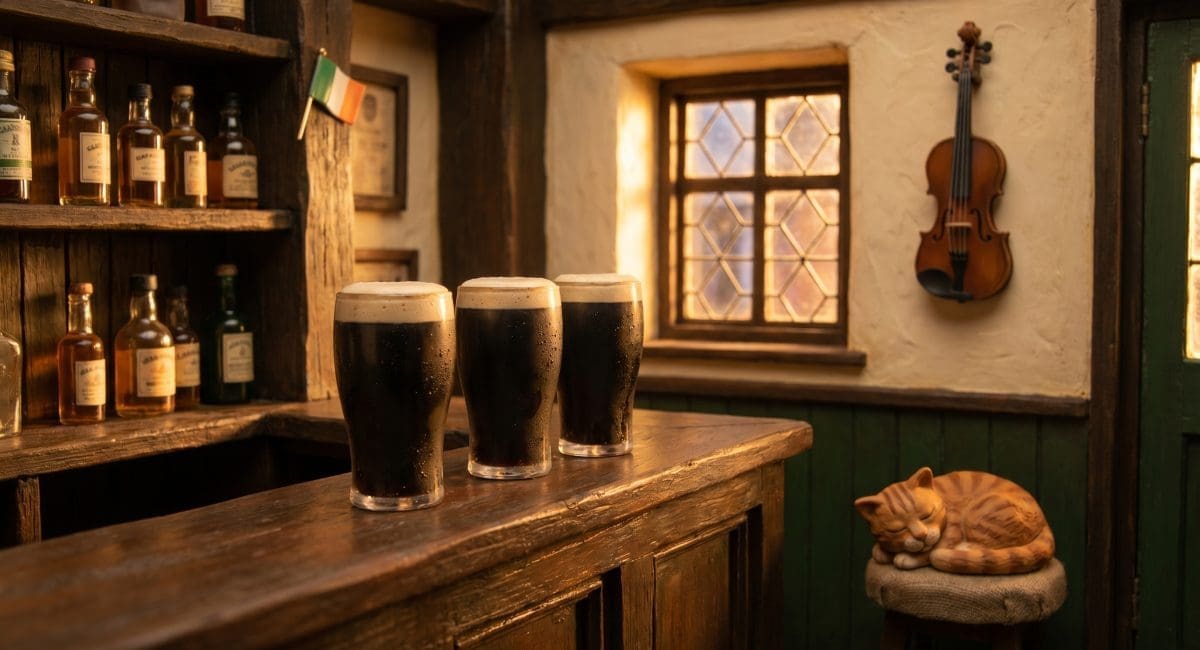
The biggest drinking days in Ireland aren’t always the ones you’d expect. St. Patrick’s Day is on the list, sure. But Ireland has a 12-pub Christmas tradition, a horse racing festival that takes over an entire city for a week, and a holiday where the pubs were closed by law for most of the 20th century.
Irish drinking culture runs deeper than green beer. It runs on regulars, on Wren Boys, on Samhain bonfires, on Guinness pulled the proper way at a pub that’s been open since 1198. None of that translates to a suburban American parade. That’s not a complaint — it’s just an observation from somebody whose great-grandfather came over from County Cork and would absolutely judge a Boston Irish Car Bomb.
This piece rounds out our drinking-days series alongside America’s biggest drinking holidays, the UK drinking calendar, Australia’s biggest drinking days, and Canada’s biggest drinking days. Below is the complete Irish calendar — ranked by cultural weight, with hangover tips you’ll need by morning.
St. Patrick’s Day
Green Beer Isn’t Irish — And the Original Wasn’t Even Green Dye
In 1914, an Irish-American doctor in New York dropped a few drops of blue laundry whitener into pale beer for a St. Patrick’s Day party. Yellow beer plus blue dye equals green. A tradition was born in a bathtub.
Meanwhile in Ireland, people were drinking Guinness, which is far too dark to turn green without an alchemical miracle.
St. Patrick’s Day is the centerpiece of the Irish drinking calendar globally, but the version Americans celebrate is a long way from how Ireland actually does it. Until 1961, Irish law prohibited pubs from opening on March 17 as a mark of religious respect for the saint. The day was for church, not for shots.
That changed when Ireland realized the rest of the world was throwing a massive party in their honor and they were stuck at home with the curtains drawn. Today, March 17 in Dublin, Galway, and Cork is huge. There are parades, packed pubs, traditional Irish music, and yes, plenty of pints. But you won’t find green beer. You’ll find Guinness, Smithwick’s, and Irish whiskey.
The Irish-American version added the green food coloring, the leprechaun hats, the “kiss me I’m Irish” t-shirts, and the Irish Car Bomb cocktail. None of those exist in Ireland in any meaningful way. Irish drinking culture on St. Paddy’s is older, deeper, and far less costumed than what you’ll find at your local Boston pub.
The Dublin parade is the centerpiece of the day. It runs from Parnell Square down O’Connell Street, across the Liffey, and finishes at St. Patrick’s Cathedral. The parade itself is family-focused — bands, floats, dance troupes, and Irish-language performances. Drinking happens after, in the pubs that line the parade route and pour pints from open until close.
Outside Dublin, the celebration is quieter and more local. Small-town parades feature actual community members rather than tourists. Trad music sessions take over corner pubs, with locals pulling out fiddles and bodhráns and the bartender turning a blind eye to closing time. The drinking is heavy but unhurried — Irish pubs run on the principle that a good pint takes time and a good conversation takes longer.
If you want a proper Irish St. Paddy’s experience as a visitor, skip Temple Bar in Dublin. That’s the tourist trap. Find a snug in a neighborhood pub like Mulligan’s, Kehoe’s, or The Gravediggers in Glasnevin. Order a pint of Guinness, let it settle for the proper 119.5 seconds, and listen to the conversation around you. That’s the day.
Guinness contains more congeners than light lagers, which makes it a heavier hangover producer than its lower ABV would suggest. Pace yourself, drink water between pints, and check our hangover prevention game plan before March 17 rolls around.
St. Stephen’s Day (December 26)
St. Stephen’s Day is Ireland’s Boxing Day, and for many regions it’s the actual biggest pub day of the year. Bigger than St. Paddy’s. Bigger than New Year’s Eve. The reason is simple: everyone has been trapped in a house with their family for 24 hours and the pubs reopen at noon like a public release valve.
The day takes its name from Saint Stephen, the first Christian martyr, but the cultural reality is that it’s the great Irish escape from Christmas dinner. Pubs are full from opening. Sport plays on every TV. Old friends who haven’t seen each other since the previous St. Stephen’s Day reconvene at the local. The Wren Boys tradition — costumed processions in rural areas — adds a layer of cultural color you won’t find anywhere else.
It’s also a recovery day, which is part of why the drinking is so social. You’re hung over from Christmas Day, the family obligations are done, and the day’s only job is to sit in a warm pub and not feel guilty about it.
Drinking on top of an existing hangover is how you turn a one-day recovery into a three-day disaster. If you’re going to the pub on Stephen’s Day, eat a real breakfast first and keep up on water. Our guide on how to cure a hangover fast has the full recovery sequence.
The 12 Pubs of Christmas
This is one of the most uniquely Irish drinking traditions on the calendar, and it doesn’t show up in the country drinking calendars of any other nation. The concept: a group commits to visiting 12 pubs in one night, with one drink at each, often in costume. Christmas-themed jumpers are standard. Santa hats are mandatory.
The unwritten rules vary by group, but generally include: no backtracking to previous pubs, a different drink at each location, and a pace fast enough that the entire route gets completed before closing time. Twelve pubs in roughly five hours means a drink every 25 minutes, which is brutal.
The tradition spreads across December weekends, peaking in the two weekends before Christmas. Office groups do it. University groups do it. Some pubs in Dublin and Galway specifically advertise themselves as “12 Pubs friendly” with shorter lines and faster service.
Twelve drinks in five hours bypasses every tolerance defense your body has. Your liver clears roughly one drink per hour. Doing the 12 Pubs means walking around with a blood alcohol level that’s still climbing when you finish. See why high tolerance doesn’t protect you for the science on why this hits so hard.
New Year’s Eve
Irish New Year’s Eve is less manic than its American or British equivalents. There’s no Times Square equivalent. There’s no drop-everything countdown chaos. Mostly, there’s a good pub, good company, and a quiet shift from one year to the next.
Champagne shows up, sure, but Irish whiskey toasts dominate at the actual stroke of midnight. Jameson, Bushmills, Redbreast — the choice signals which side of Ireland’s whiskey debate you fall on. Pubs are full but not insane. Most Irish people will tell you Christmas and St. Stephen’s Day are bigger drinking events than New Year’s Eve.
The exception is Dublin, which throws a city festival called New Year’s Festival Dublin with street music, fireworks, and a 3FE-sponsored countdown. That’s the closest Ireland gets to the Hogmanay-style chaos happening just across the water in Edinburgh.
Whiskey hangovers are notoriously rough due to high congener content. If you’re toasting with Jameson at midnight, hydrate before bed and have a real breakfast lined up for January 1. Our best hangover drinks guide covers what actually helps.
Halloween (Samhain)
Halloween was literally invented in Ireland. The modern holiday traces directly back to Samhain (pronounced “sow-in”), the ancient Gaelic festival marking the end of harvest season and the beginning of winter. Bonfires, costumes, divination rituals, and the belief that the boundary between worlds was thinnest on October 31 — all of it is Irish in origin.
When Catholic missionaries arrived, they overlaid All Hallows’ Eve on the existing Samhain traditions. Irish immigrants carried the holiday to America in the 19th century, where it got commercialized into the costume-and-candy machine we know today. Then America exported its commercial version back to Ireland, where it now coexists with the older traditions.
Modern Irish Halloween is a real drinking holiday. Pubs run themed nights. Costume parties dominate the weekend nearest October 31. Bonfires still burn in Dublin’s Phoenix Park and rural areas. The cultural depth Americans don’t always see: Halloween in Ireland still feels like Samhain underneath the costume layer.
Costume parties produce some of the worst hangovers because nobody tracks how much they’ve had when they’re in character. Set a drink count before you put the costume on, and stick to it.
The Easter Paradox
Good Friday is the most interesting drinking day in Ireland because for nearly a century it was a non-drinking day. From 1927 until 2018, Irish law banned the sale of alcohol on Good Friday. Pubs closed. Off-licenses shut. The country went officially dry for one day a year.
The cultural reality, of course, was that Irish people simply bought all their alcohol on Holy Thursday instead. Off-licenses had their biggest single trading day of the spring on the day before the ban. The “Holy Thursday rush” became its own tradition — people stocking up like they were preparing for a hurricane, except the hurricane was a religious observance.
The 2018 law change finally allowed Good Friday alcohol sales for the first time in 91 years. The reaction in Ireland was muted. Most people had been drinking on Good Friday anyway, just at home. The pubs that opened that first legal Good Friday in 2018 reported steady but unspectacular trade. The genuine winners were pubs in Northern Ireland and Britain, which had served as a release valve for the previous 90 years.
Easter Sunday and Easter Monday function as the “make up for lost time” rebound. Family gatherings, pub roasts, and the unofficial start of beer-garden season all converge on Easter weekend.
A four-day weekend with drinking on three of those days is harder on your body than a single big night. Schedule a recovery day in the middle — Saturday is usually the best candidate.
Galway Race Week
Galway Race Week is Ireland’s Melbourne Cup. It runs the last week of July into the first week of August, draws over 150,000 visitors across seven days, and turns the entire city of Galway into one continuous pub.
The festival started in 1869 as a two-day meeting at Ballybrit Racecourse and grew to seven days in 1999. The biggest days are Wednesday (the Tote Galway Plate) and Thursday (Ladies’ Day, with the Guinness Galway Hurdle). Ladies’ Day is the peak — fashion, racing, champagne tents, and a level of all-day drinking that rivals anything on the international racing calendar.
Bars across Galway extend hours and run themed Race Week menus. Bottomless prosecco brunches start at 11 a.m. Hotels book out months in advance. The energy is closer to Mardi Gras than to a typical horse race — this is a city committed to a week of organized debauchery.
For Americans, the closest equivalent is the Kentucky Derby, except imagine if the Derby ran for seven days and the entire host city participated. That’s Galway Race Week.
Multi-day drinking events stack damage faster than your body can clear it. Sleep matters more than the cure. Our breakdown on why hangovers get worse with age applies double during Race Week.
Bank Holiday Mondays
Ireland has bank holiday Mondays in May, June, August, and October, plus a newer holiday on the first Monday of February for St. Brigid’s Day (added in 2023). Each one anchors a long-weekend drinking culture similar to Canada’s Victoria Day or Civic Holiday weekends.
The May bank holiday weekend kicks off the warm-weather drinking season — beer gardens fill up, BBQs start happening, and pubs begin extending their outdoor seating. The June and August bank holidays are summer continuation events. The October bank holiday weekend overlaps with Halloween, which compounds the drinking volume.
St. Brigid’s Day in early February is the newest addition and the smallest of the bank holidays culturally. It’s a real celebration of an ancient Irish saint, but the modern drinking culture around it hasn’t fully formed yet. Ten years from now, it might be a major entry on this list. For now, it’s a quieter long weekend.
Quick-Reference: Ireland’s Biggest Drinking Days
| Occasion | When | Drink of Choice | Hangover Risk |
|---|---|---|---|
| St. Patrick’s Day | March 17 | Guinness, Irish whiskey | 🔴 Very High |
| St. Stephen’s Day | December 26 | Guinness, Smithwick’s | 🔴 Very High |
| The 12 Pubs of Christmas | December weekends | Beer, shots, anything | 🔴 Very High |
| New Year’s Eve | December 31 | Irish whiskey, champagne | 🟠 High |
| Halloween (Samhain) | October 31 | Beer, themed cocktails | 🟠 High |
| Easter Weekend | March/April (varies) | Beer, wine | 🟡 Medium-High |
| Galway Race Week | Last week of July | Champagne, Guinness | 🔴 Very High |
| Bank Holiday Mondays | May, June, August, October | Beer, wine | 🟡 Medium |
Frequently Asked Questions
What is the biggest drinking day in Ireland?
It depends on how you measure. By global cultural weight, St. Patrick’s Day is the biggest drinking day in Ireland and worldwide. By actual pub volume within Ireland, St. Stephen’s Day on December 26 often beats it because of the post-Christmas pent-up demand. By multi-day total alcohol consumption, Galway Race Week likely tops the list with seven consecutive days of festival-level drinking.
Why was St. Patrick’s Day a “dry” day in Ireland until the 1960s?
Irish law required pubs to close on March 17 as a mark of religious respect for the saint. The ban was in place from 1927 until 1961. The thinking was that St. Paddy’s was a holy day of obligation, and drinking in pubs would undercut its religious meaning. Once the law lifted, Ireland had to figure out how to celebrate a holiday the entire diaspora had already turned into a global event.
What’s the difference between Irish and Irish-American St. Paddy’s?
Almost everything visual. Green beer, leprechaun hats, “kiss me I’m Irish” t-shirts, the Irish Car Bomb cocktail, and Shamrock Shakes are American inventions. Ireland’s version focuses on parades, family, traditional Irish music, and pints of Guinness or Irish whiskey. Irish people generally find the American version baffling but harmless — like watching someone wear a kimono to a Pizza Hut.
What is the 12 Pubs of Christmas?
A uniquely Irish drinking tradition where a group visits 12 pubs in one night, having one drink at each. Costumes, usually Christmas jumpers and Santa hats, are standard. The tradition is concentrated in December weekends in Dublin, Galway, and Cork. Strict rules apply: no backtracking, different drink at each pub, complete the route before closing.
Did Halloween really come from Ireland?
Yes. Halloween descends directly from Samhain, the ancient Gaelic festival marking the end of harvest. Bonfires, costumes, divination rituals, and the belief that the boundary between worlds was thinnest on October 31 are all Irish in origin. Catholic missionaries overlaid All Hallows’ Eve on the existing tradition, and Irish immigrants carried it to America in the 1800s, where it got commercialized into the modern holiday.
How does Irish drinking culture compare to American drinking culture?
Irish drinking is more social, slower-paced, and pub-centered. The pub is a community institution where people of all ages gather, conversations matter, and a single pint can last 45 minutes. American drinking tends toward higher-volume, faster-pace, and event-driven consumption — tailgates, frat parties, sports bars. Both cultures drink heavily, but the rituals around how alcohol fits into daily life are different.
What’s the best way to recover from an Irish holiday hangover?
The fundamentals don’t change regardless of where you drank. Hydration is step one — alcohol is a diuretic and Guinness is dehydrating despite its low carbonation. Electrolytes speed recovery. Real food with protein and complex carbs helps stabilize blood sugar. Time is the only true cure. The Irish answer involves a full Irish breakfast and a strong cup of tea, and that holds up against any hangover protocol on the planet.
Sources
- Saint Patrick’s Day — Wikipedia (history and cultural origins)
- Samhain — Wikipedia (Halloween’s Irish origin)
- Galway Races — Wikipedia (festival history and attendance data)
- The Galway Races Summer Festival 2026 — Official site
- Holidays in Ireland — Auto Europe travel guide
- Holidays and Festivals in Ireland 2026 — Rick Steves’ Europe
- St. Stephen’s Day — Wikipedia
- Intoxicating Liquor Act 2018 — Wikipedia (Good Friday law change)
If your relationship with alcohol has become a pattern that worries you or someone close to you, support is free and confidential. The SAMHSA National Helpline is available 24/7 at 1-800-662-4357. Irish readers can reach the HSE Drug and Alcohol Helpline at 1800 459 459. No judgment — just help when you want it.