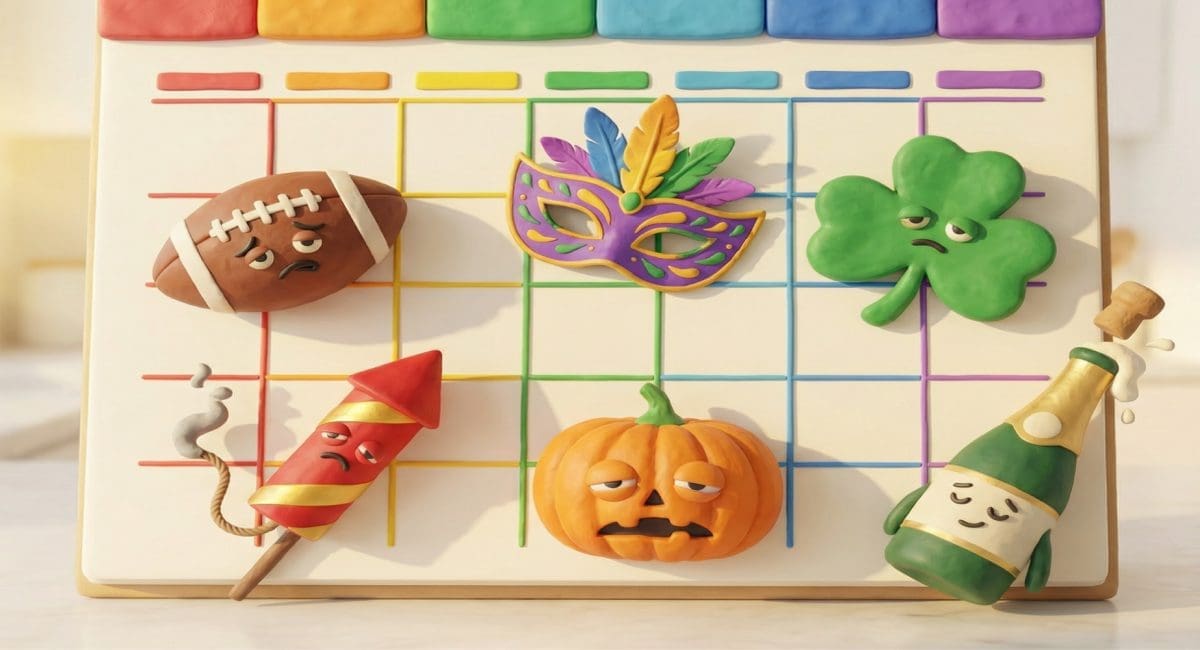
The biggest drinking holidays in America follow a predictable calendar. Super Bowl Sunday kicks off February with 325 million gallons of beer. Mardi Gras follows with the highest average drinks per person of any holiday. Then St. Patrick’s Day, Fourth of July, Halloween, and Blackout Wednesday march through the year before the holiday season and New Year’s Eve close it out with a bang.
Here’s what nobody tells you though. Each of these biggest drinking holidays produces a different kind of hangover. Champagne on New Year’s Eve hits different than all-day beer on the Fourth of July. Sugar-loaded Hurricanes on Mardi Gras wreck you differently than whiskey and beer combos on St. Patrick’s Day. The science behind why varies from holiday to holiday — and so does the best way to prevent the damage.
Fifty-five percent of Americans admit to drinking more than usual on holidays. For Gen Z, that number jumps to 65%. And if you’re reading this, you probably already know which holidays tend to get away from you.
You’ll also notice we’ve included US military service branch birthdays throughout this calendar. These won’t show up on most drinking holiday lists, but they’re real celebrations for the people who serve and have served. We’re not here to perpetuate stereotypes — not every service member drinks, and military culture has evolved significantly around alcohol awareness. But branch birthdays are milestones that military communities take pride in, and sometimes that celebration includes a few drinks. Just like any other group of people marking something they care about.
This is your month-by-month survival guide. We’ll walk through every major drinking holiday in America, explain why each one produces its own brand of misery, and give you the science-backed strategies to make it through all of them. Consider it your year-round hangover prevention calendar — bookmark it, because you’re going to need it in February.
February
Super Bowl Sunday — The Beer Marathon
The Super Bowl isn’t technically a holiday. Tell that to the 200 million Americans who watch it every year. An estimated 325 million gallons of beer are consumed on Super Bowl Sunday alone, making it one of the biggest drinking holidays on the calendar by sheer volume.
The hangover science here is straightforward. It’s not about what you’re drinking — it’s about how much and for how long. A typical Super Bowl party runs four to five hours. That’s a slow accumulation of beer after beer after beer, usually paired with salty, greasy snacks that make you thirstier and encourage more drinking.
Beer is relatively low in congeners compared to dark liquors, so the hangover isn’t as toxic. But the volume creates problems. All that liquid overwhelms your kidneys, flushing out electrolytes. The sodium from wings and chips triggers water retention and bloating. And staying up late disrupts your sleep cycle, compounding everything. The Super Bowl hangover is a volume hangover — death by a thousand sips.
Survival tip: Alternate every other beer with a glass of water. Set a pace of one beer per hour max. Eat protein-heavy foods instead of just salty snacks — they slow alcohol absorption without making you thirstier.
Mardi Gras — The Sugar Bomb
Mardi Gras holds the crown. Americans consume an average of 4.5 drinks on Fat Tuesday — the highest of any holiday measured. And the drink of choice is the problem. Hurricanes, Hand Grenades, and frozen daiquiris are loaded with sugar, artificial mixers, and cheap liquor. That combination is a hangover recipe that’s almost impossible to survive cleanly.
Sugar is the hidden villain of Mardi Gras hangovers. Your body processes sugar and alcohol through similar metabolic pathways, so they compete for your liver’s attention. High-sugar drinks also mask the taste of alcohol, making it easy to blow past your limit without realizing it. Then your blood sugar spikes and crashes overnight, leaving you shaky, nauseous, and headache-prone the next morning.
On top of that, the sugary cocktails Mardi Gras is famous for tend to contain high levels of congeners — those toxic byproducts of fermentation that make dark liquors and cheap mixers especially punishing. It’s a triple threat of sugar, volume, and toxins.
Survival tip: If you can, choose simpler drinks with fewer mixers. A vodka soda won’t win any beads, but your liver will thank you. Eat a substantial meal before the festivities and keep snacking throughout the night.
March
St. Patrick’s Day — The All-Day Marathon
St. Patrick’s Day is the holiday men associate with alcohol more than any other — 36% of men tie this day directly to drinking. And for good reason. It’s one of the few biggest drinking holidays that actively encourages all-day consumption. Parades start in the morning. Bar specials begin at noon. By evening, you’ve been drinking for eight to ten hours straight.
The science problem here is twofold. First, all-day drinking keeps your blood alcohol level elevated for hours on end. Your liver never gets a chance to catch up. Acetaldehyde — the toxic byproduct that causes most hangover symptoms — accumulates steadily instead of spiking and clearing.
Second, the classic St. Patrick’s Day combination of beer and whiskey is a congener double whammy. Irish car bombs, boilermakers, and shots of Jameson between pints of Guinness mix low-congener and high-congener drinks together. Your body has to process both at once. Research shows that drinks high in congeners — like bourbon and dark beer — produce significantly worse hangovers than low-congener options like vodka or light beer.
Survival tip: Pace yourself with a hard cutoff time. If you start drinking at noon, commit to stopping by a set hour. Stick to one type of drink if possible. Mixing beer and whiskey all day is the fastest path to a brutal St. Patrick’s Day hangover.
June
Army Birthday — June 14
The US Army is the oldest branch of the military, founded on June 14, 1775. That makes Army birthday celebrations some of the longest-running military traditions in the country. I can’t speak to exactly how the Army celebrates — but 250 years of tradition and a June date that lines up perfectly with summer weather? I’d presume a few drinks are involved.
July
Fourth of July — The Heat Multiplier
Fourth of July drinking is sneaky. You’re outside. It’s hot. You’re surrounded by coolers full of ice-cold beer. Time feels irrelevant because it’s a barbecue, not a bar. And that’s exactly why this holiday catches so many people off guard.
Heat changes the alcohol equation entirely. When it’s hot, your body diverts blood flow to your skin to cool you down, which means less blood flow to your digestive system. Alcohol absorbs faster. Dehydration accelerates. You sweat out electrolytes while replacing them with beer — which is a diuretic that makes you lose even more fluid. It’s a vicious cycle that compounds with every hour in the sun.
The National Safety Council considers the Fourth of July one of the most dangerous days of the year on the road. A significant portion of those accidents involve alcohol. The combination of all-day outdoor drinking, heat exhaustion, and impaired judgment is genuinely dangerous.
Safety note: Heat and alcohol are a dangerous combination. Watch for signs of heat exhaustion — dizziness, excessive sweating, rapid heartbeat, nausea. These overlap with intoxication symptoms, which makes it hard to tell what’s happening. Drink water aggressively. Take breaks in the shade. And never drive after drinking, especially on the Fourth.
Survival tip: Match every alcoholic drink with a full glass of water. Stay in the shade when you can. Eat throughout the day — don’t just drink on an empty stomach at a barbecue. Consider adding an electrolyte drink between beers to replace what you’re sweating out.
August
Coast Guard Birthday — August 4
The Coast Guard was founded on August 4, 1790, making it the fourth-oldest military branch. Coast Guard members protect US waterways, conduct search and rescue, and enforce maritime law — often in conditions that would make the rest of us seasick just thinking about it. How they celebrate their birthday is their business, but an August date in the middle of summer sounds like a solid excuse for a cookout and a cold one.
September
Air Force Birthday — September 18
The Air Force became its own branch on September 18, 1947, splitting from the Army after World War II. It’s the youngest of the traditional branches (we’ll get to Space Force later). September puts the Air Force birthday right at the tail end of summer — perfect timing for one last warm-weather celebration before fall sets in.
October
Navy Birthday — October 13
The US Navy traces its origins to October 13, 1775, when the Continental Congress authorized a small fleet to disrupt British supply lines. Sailors have been celebrating ever since. October also puts the Navy birthday in the same month as Halloween — so if you’re a veteran or active duty Navy and you’re celebrating both, that’s a two-event month. Plan accordingly.
Halloween — The Sugar Trap
Halloween flies under the radar as a drinking holiday, but the data tells a different story. Adults aged 20 to 24 drink the heaviest on Halloween, averaging nearly four drinks. It’s the youngest-skewing drinking holiday on the list, and the combination of costumes, themed parties, and candy creates a unique hangover profile.
The science here is similar to Mardi Gras but with a twist. Halloween cocktails are loaded with sugar, and they’re usually consumed alongside actual candy. That double sugar hit causes a dramatic blood sugar spike followed by a crash. Your pancreas pumps out insulin to deal with the overload. Then your blood sugar tanks overnight, leaving you waking up shaky, irritable, and nauseous on top of the standard hangover symptoms.
There’s also a behavioral factor. Costumes create psychological distance — you’re “in character,” which makes it easier to drink more than you normally would. When you’re dressed as someone else, your inhibitions drop further than they already would from alcohol alone.
Survival tip: Eat a real meal before the party, not just candy. Watch out for punch bowls and themed cocktails where you can’t gauge the alcohol content. And remember — the costume comes off, but the hangover stays.
November
Marine Corps Birthday — November 10
The Marine Corps was founded on November 10, 1775 at Tun Tavern — a bar in Philadelphia. The drinking is literally baked into the origin story.
I can speak from personal experience on this one. The Marine Corps Birthday Ball is a formal, respected event — Dress Blues, the reading of General Lejeune’s 1921 birthday message, and the iconic cake cutting with a Mameluke sword. The first slice goes to the guest of honor. The second goes to the oldest Marine present, who passes it to the youngest. It symbolizes the passing of knowledge and tradition from one generation to the next. Marines take it seriously.
The heavy drinking? That mostly happens before and after the Ball, not during it. Nobody wants to be the Marine who embarrasses themselves — or worse, gets into legal trouble — at the formal event. So the Ball stays classy. The pre-game and afterparty? That’s a different story entirely.
And here’s the kicker — November 10 falls the day before Veterans Day. That’s a back-to-back situation that practically demands a hangover prevention plan.
Blackout Wednesday — The Reunion Binge
The Wednesday before Thanksgiving is the biggest bar sales night of the year. It’s not even close. Every bar in America knows it. They staff up, stock up, and brace for the wave. The reason is simple — everyone comes home. College students on break, adults visiting their hometowns, old friends reconnecting. It’s a reunion in bar form.
This is one of the biggest drinking holidays because of how it’s structured. Unlike a Super Bowl party or a barbecue, Blackout Wednesday is unstructured drinking. There’s no game to watch. No meal to anchor the evening. No event with a start and end time. Just catching up, round after round, with people you haven’t seen in months.
That catching-up dynamic is the problem. Conversation drives the pace. Someone orders a round. Someone else orders the next one. You’re matching drink for drink with three or four different people across the night. Meanwhile, most people skip dinner because they’re “saving room for Thanksgiving.” Drinking fast, on an empty stomach, with no natural stopping point — that’s the perfect recipe for acetaldehyde overload.
And no, Thanksgiving dinner the next day isn’t a hangover cure. The tryptophan in turkey making you sleepy is mostly a myth — it’s the overeating that knocks you out. But a big meal the morning after excessive drinking can help stabilize your blood sugar and replenish nutrients, so at least the timing works in your favor.
Survival tip: Eat dinner before you go out. Set a drink limit and stick to it. The reunion energy will push you to keep up with everyone — resist it. Your body doesn’t care how many friends you haven’t seen since August.
December
Christmas and the Holiday Season — The Slow Burn
Christmas isn’t a single-night drinking event. It’s a season. Office parties start in early December. Family gatherings pile up. Friendsgivings, holiday brunches, cocktail parties, and New Year’s prep events stack on top of each other for three to four weeks straight.
This is the sneakiest hangover pattern on the biggest drinking holidays calendar. No single night is necessarily excessive. But your liver never gets a full reset. It takes your liver roughly 24 to 48 hours to fully clear alcohol and its byproducts. When you’re drinking every other night for a month, you’re compounding the inflammatory effects. Each event starts on top of residual fatigue, dehydration, and low-grade inflammation from the last one.
The drink variety also complicates things. Monday it’s wine at dinner. Wednesday it’s cocktails at a holiday party. Friday it’s beer at a friend’s place. Saturday it’s eggnog with rum. Your body is processing different types of alcohol with different congener profiles in rapid succession. Switching between drink types — especially mixing clear and dark spirits — tends to increase hangover severity.
Survival tip: Build in recovery nights. Not every event requires drinking. Pick your battles — go hard at the events that matter and nurse a club soda at the rest. Your liver needs at least two consecutive dry days between sessions to fully recover during the holiday season.
Space Force Birthday — December 20
The Space Force became the newest military branch on December 20, 2019. It’s so new that celebration traditions are still being written. We’re not sure what a Space Force birthday party looks like yet, but we’re guessing Tang is involved. Either way, December 20 puts it right in the middle of the holiday season — so if you’re Space Force and celebrating, the slow-burn strategy above applies to you too.
New Year’s Eve — The Grand Finale
New Year’s Eve closes the year as the biggest drinking holiday by cultural weight. Average consumption hits 4.4 drinks — just behind Mardi Gras. But the binge rates are the highest of any holiday. Forty-seven percent of men and 40% of women report binge drinking on NYE. And 27.3% of men and 16.7% of women report blacking out.
Champagne is the culprit, and it’s not just about the alcohol content. Carbonation accelerates alcohol absorption in your stomach. The bubbles increase the rate at which ethanol passes through your stomach lining and into your bloodstream. Studies show that carbonated alcoholic drinks produce higher blood alcohol levels faster than the same amount of flat alcohol. That’s why two glasses of champagne can hit harder than two glasses of wine.
There’s also the “last hurrah” psychology. Many people go into New Year’s Eve planning to start Dry January the next day. That mindset encourages maximum indulgence — one final blowout before the reset. It’s the same psychology that drives Mardi Gras consumption before Lent. And it leads to the same result: waking up January 1st feeling absolutely wrecked and wondering if the resolution was worth it.
Survival tip: Eat a substantial meal before midnight. Alternate champagne with water — one glass for every glass of bubbly. If you’re going to toast at midnight, nurse your drinks earlier in the evening. The fastest hangover recovery strategies start before the hangover does.
Your Holiday Hangover Survival Cheat Sheet
Every one of America’s biggest drinking holidays has a different hangover profile. Here’s the quick-reference breakdown so you know what you’re up against — and what to do about it.
| Holiday | Hangover Type | Primary Drinks | #1 Prevention Tip |
|---|---|---|---|
| Super Bowl | Volume overload | Beer | Alternate beer with water every other round |
| Mardi Gras | Sugar crash + toxins | Hurricanes, frozen cocktails | Choose simpler drinks with fewer mixers |
| St. Patrick’s Day | Congener overload | Beer + whiskey | Stick to one type of drink all day |
| Fourth of July | Heat + dehydration | Beer, mixed drinks | Match every drink with a glass of water |
| Halloween | Blood sugar crash | Themed cocktails, candy | Eat a real meal, not just candy |
| Blackout Wednesday | Empty stomach binge | Bar drinks, shots | Eat dinner before going out |
| Christmas Season | Cumulative fatigue | Wine, cocktails, eggnog | Build in recovery nights between events |
| New Year’s Eve | Carbonation spike | Champagne, cocktails | Alternate bubbly with still water |
Prevention Tips That Work for Every Holiday
No matter which of America’s biggest drinking holidays you’re celebrating, the fundamentals stay the same. Eat a substantial meal before you start drinking — protein and healthy fats slow alcohol absorption significantly. Stay hydrated by matching every alcoholic drink with a glass of water. Know your limits and set them before the first drink, not after the third.
Consider adding a DHM supplement 30 to 60 minutes before you start drinking. DHM helps your liver process alcohol more efficiently and reduces the GABA rebound that causes hangxiety. It’s not a magic shield, but paired with the basics, it gives your body a real advantage.
Get your full science-backed prevention game plan here. And if you do wake up hurting, check out our guide on how to cure a hangover fast. For the morning after, our guide to the best hangover foods and best hangover drinks has you covered.
A serious note: Holiday drinking is fun until it isn’t. Alcohol poisoning, drunk driving, and alcohol-related accidents spike on every single one of these holidays. Never drive after drinking. Watch out for friends who’ve had too much. And if you or someone you know is struggling with alcohol, the SAMHSA National Helpline is available at 1-800-662-4357. It’s free, confidential, and available 24/7.
Frequently Asked Questions
What is the biggest drinking day in America?
It depends on the metric. Mardi Gras tops the chart for average drinks consumed per person at 4.5. But Blackout Wednesday (the night before Thanksgiving) is the biggest bar sales night of the year. New Year’s Eve has the highest binge drinking and blackout rates. Each of America’s biggest drinking holidays earns the title in a different way.
Why do different holidays cause different hangovers?
Different drinks contain different levels of congeners — toxic byproducts of fermentation. Dark liquors like whiskey and bourbon contain more congeners than clear spirits like vodka. Sugar-heavy cocktails cause blood sugar crashes on top of standard symptoms. And environmental factors like heat on the Fourth of July or sustained drinking over the holiday season compound the effects in unique ways.
How can I prevent a hangover on holidays?
Eat before you drink. Stay hydrated by alternating alcoholic drinks with water. Set a limit and stick to it. Consider taking a DHM supplement 30 to 60 minutes before drinking. And get enough sleep — alcohol disrupts your sleep cycles, which makes every other symptom worse.
Is the day before Thanksgiving really the biggest drinking night?
By bar sales, yes. Blackout Wednesday consistently generates the highest single-night bar revenue of the year in most US markets. MADD reports that the Thanksgiving holiday period produces more drunk driving fatalities than the Christmas holiday period. The combination of time off work, hometown reunions, and no structured evening makes it a perfect storm for excessive drinking.
Does champagne really make hangovers worse?
The carbonation in champagne and sparkling wine increases the rate at which alcohol absorbs into your bloodstream. Studies show that carbonated alcoholic drinks produce higher blood alcohol levels faster than the same amount of non-carbonated alcohol. So yes — two glasses of champagne can hit harder than two glasses of still wine with the same alcohol content.
Sources
- National Institute on Alcohol Abuse and Alcoholism. “Hangovers.” NIAAA.
- National Safety Council. “Drunk Driving.” NSC.
- Mothers Against Drunk Driving. “Drunk Driving Statistics.” MADD.
- Rohsenow, D.J. & Howland, J. (2010). “The Role of Beverage Congeners in Hangover and Other Residual Effects of Alcohol Intoxication.” Current Drug Abuse Reviews.
- Roberts, C. & Robinson, S.P. (2007). “Alcohol Concentration and Carbonation of Drinks: The Effect on Blood Alcohol Levels.” Journal of Forensic and Legal Medicine.
- SAMHSA. “National Helpline.” Substance Abuse and Mental Health Services Administration.
🍺 A note before you go: Hangovers are miserable, but if you’re drinking to the point of needing recovery strategies on a regular basis, that’s worth paying attention to. There’s no judgment here — but there is help available if you want it. SAMHSA’s National Helpline is free, confidential, and available 24/7.