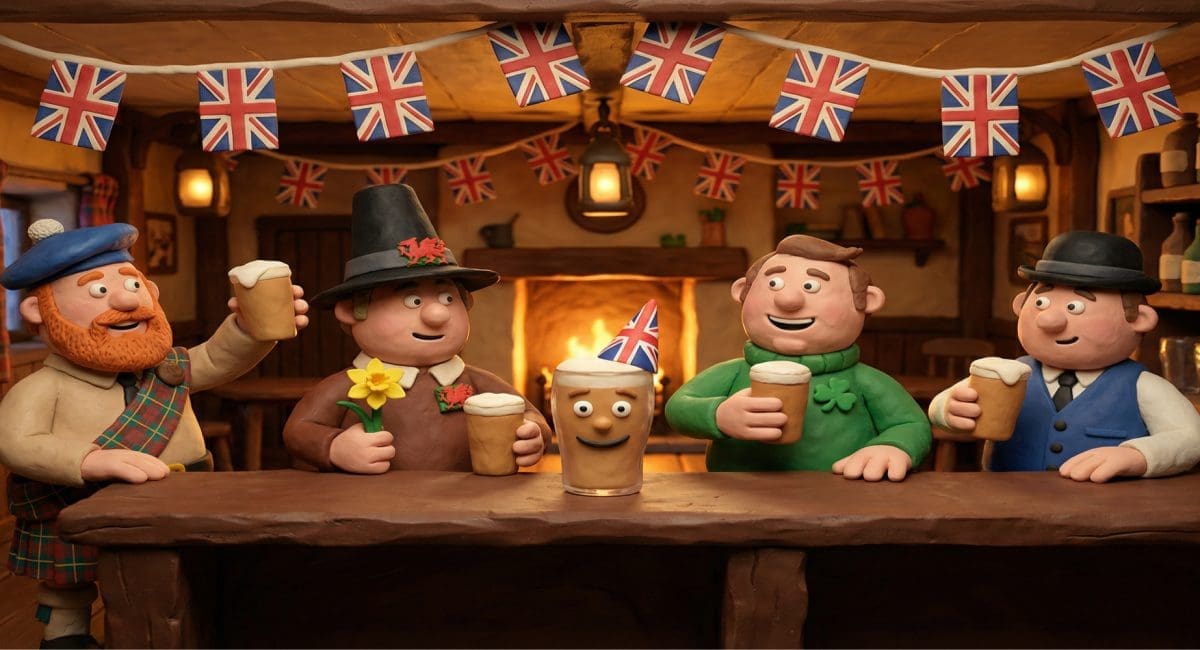
This guide covers the biggest UK drinking holidays across England, Scotland, Wales, Northern Ireland, and the Crown Dependencies. We’ll explain the traditions, the chaos, and how to survive all of it with science-backed hangover prevention tips.
There’s a moment every American experiences the first time they walk into a proper British pub. The low ceilings, the worn wooden bar, the smell of real ale and decades of good conversation. You order a pint — carefully, because asking for “a beer” will earn you a look — and suddenly you understand something about British drinking culture that no travel guide ever quite captures.
I’ve had that moment more than once. Part of my family traces back to Portsmouth in southern England, with the earliest roots arriving on American shores in the 1670s — long before there was a United States to arrive in. Another branch came over from Northern Ireland between the 1830s and 1880s. So when I write about British drinking culture and the UK’s biggest drinking holidays, I’m not writing as a tourist. I’m writing as someone with genuine skin in the game — and a deep appreciation for where part of me actually comes from.
I’m also writing as an American, which means I’ll probably get a few things wrong. If I do, I apologize in advance. No disrespect is intended. Quite the opposite.
What strikes me most about British drinking culture isn’t the volume — though the volume is impressive. It’s the ritual. Americans drink hard on specific holidays and call it a tradition. The British have woven drinking into the fabric of daily life so thoroughly that the holidays almost feel like an excuse to do what they’d be doing anyway. The pub isn’t where you go to drink. It’s where you go to live, and the drinking happens to come with it.
This guide covers the biggest drinking days across the UK and its Crown Dependencies — England, Scotland, Wales, Northern Ireland, the Channel Islands, and the Isle of Man. We’ll walk through the UK drinking calendar, explain the traditions, and arm you with the science-backed hangover prevention tips you’ll need if you’re ever lucky enough to experience any of this firsthand.
The Pub: Understanding the Foundation First
Before any of the UK drinking holidays make sense, Americans need a quick education on the pub. This isn’t a bar. Don’t call it a bar. A British pub — short for public house — is a community institution with roots stretching back to Roman taverns and Anglo-Saxon alehouses. Samuel Pepys called it “the heart of England” in the 17th century, and that still holds today. There are more than 40,000 pubs across the UK, and even as that number has declined from a peak of nearly 70,000 in 1980, the ones that remain are deeply woven into local identity.
The rules are different here too. You order at the bar — no table service. You buy in rounds, which is both a social contract and a financial commitment you should think carefully about before joining a large group. You don’t ask for “a beer.” You learn what’s on tap and you make a decision like an adult.
Most importantly, the pub is where community actually happens. Weddings are planned here. Grief is processed here. Arguments about football are settled — or more often dramatically escalated — here. My Portsmouth ancestors almost certainly spent considerable time in establishments exactly like this. That thought truly means something to me.
Hogmanay — Scotland Goes Absolutely Feral (New Year’s Eve)
Let’s start in Scotland, because Scotland doesn’t mess around when it comes to drinking holidays.
While the rest of the world treats New Year’s Eve as a single night of celebration, Scotland turns it into a multi-day national event with ancient roots, ritual whisky consumption, and a government-mandated recovery day built right into the calendar. For centuries, Christmas was little observed in Scotland — banned after the Reformation and only recognised as a public holiday in 1958 — making Hogmanay the country’s main winter celebration. All that gift-giving and feasting energy that goes into Christmas elsewhere? Scotland redirected it straight into New Year’s Eve. For generations.
The Edinburgh Hogmanay celebrations in 1996–97 were recognised by the Guinness Book of Records as the world’s largest New Year’s party — around 400,000 people in attendance. Times Square wishes it was this good.
The centrepiece tradition is first-footing. The moment the clock strikes midnight, people across Scotland start heading to the homes of loved ones to be the first-footer — the first person to cross the threshold in the new year. The first-footer sets the precedent for the year ahead and is always welcomed with a wee dram of whisky. Traditionally you bring gifts — coal, shortbread, black bun, and whisky. Showing up empty-handed is considered truly bad luck.
There’s also a strong preference for tall, dark-haired men as first-footers — a superstition that traces back to the Viking invasions, when a fair-haired stranger at your door meant serious trouble. Then there’s the Stonehaven Fireballs ceremony, where locals swing flaming balls through the streets at midnight to ward off evil spirits. The only drink with which to properly toast the bells at Hogmanay is, of course, Scotch whisky.
The Scottish government eventually granted January 2nd as an official bank holiday specifically because people were going to work with pounding headaches after too much whisky. The hangover recovery day is literally written into law. That’s a level of institutional self-awareness America has never come close to achieving.
Hangover tip: Hogmanay is a marathon, not a sprint. First-footing can continue well into the early hours of January 1st. Take your DHM supplement before the bells, hydrate between drams, and respect the steak pie tradition the morning after. The Scots have been handling this for centuries. Follow their lead.
Mad Friday — The Night Britain Goes Completely Off the Rails
No American equivalent exists for this one. None.
Mad Friday — also known regionally as Black Eye Friday, Builders’ Friday, Factory Friday, and in parts of Northeast Scotland, “Feel Friday” (feel meaning foolish in the local Doric dialect) — is the last Friday before Christmas. It’s the night when the entire British workforce collectively decides it has suffered enough and heads straight to the pub. It’s arguably the biggest single drinking day in the UK drinking calendar.
Alcohol sales on Mad Friday rise by a staggering 142% compared to any other Friday. An estimated 18 million people go out. In 2024, pubs sold 10.9 million pints in a single day.
Ambulance trusts around the country deploy mobile drunk tanks in city centres — purpose-built units with beds, restraint straps, and showers — just to handle the volume. Manchester erects temporary metal detectors in the busiest areas. Police forces across the country put out public warnings every single year. The term originated as jargon used by the NHS and police, and entered the popular lexicon from there. From 2013, the press began using “Mad Friday” specifically to avoid confusion with the American Black Friday shopping event growing in the UK.
The regional name variations tell their own story. Black Eye Friday in the North East references the inevitable pub brawls. Builders’ Friday and Factory Friday mark the tradition of construction and factory workers finishing at noon and heading out in their work gear. It’s simultaneously the most British and most chaotic thing imaginable.
Hangover tip: Mad Friday hangovers are legendary. You’re drinking after a full year of work stress, in cold December weather, often on an empty stomach, alongside equally enthusiastic colleagues. Pre-load with a solid meal, pace the rounds, and keep electrolytes on standby. Your Boxing Day self will thank you.
Boxing Day — The Morning After That Became Its Own Holiday
Here’s something that baffles most Americans: in the UK, December 26th is a bigger deal than December 24th.
Boxing Day is a permanent public holiday with its own specific practices and traditions — while Christmas Eve is just another working day. The origins are truly fascinating. It traces back to wealthy households giving gift boxes to servants the day after Christmas, hence the name. The servants worked Christmas Day serving their employers, then received their own Christmas boxes on the 26th.
Today Boxing Day means family, sport, and the pub. Traditionally it’s a day for seeing the other set of parents or grandparents, playing board games, and drinking mulled wine — with tabloid photographers gleefully documenting the city centre chaos every single year. The Premier League also plays a full Boxing Day fixture schedule, meaning pubs across the country fill up with fans watching multiple matches back to back. It’s Christmas, a bank holiday, and match day simultaneously. The combination is formidable.
Hangover tip: You’ve already been drinking since Mad Friday. Pace Boxing Day accordingly. The full English breakfast the morning after is folk wisdom that actually works — eggs, fat, and carbs doing legitimate recovery science.
Easter Weekend — Four Days, One Mission
The British Easter weekend is a four-day affair in England, Wales, and Northern Ireland — Good Friday through Easter Monday. Scotland opts out of Easter Monday as a bank holiday, which says something about Scottish priorities.
The real significance here is timing. Easter weekend typically falls in late March or April, which means it’s the first proper opportunity for pub garden drinking after the long British winter. England’s official pub garden season — calculated by actual weather data — begins around May 7th on average. Easter gives drinkers a hopeful early preview. A sunny Easter Monday in a British beer garden is one of life’s genuine pleasures, and something every American should experience at least once.
Good Friday has its own complicated pub culture too — historically a solemn day, but practically speaking a day off work with pubs open. The tension between tradition and a free afternoon has historically been resolved in favour of the pub.
Bank Holiday Weekends — Britain’s Recurring Excuse
England and Wales get eight bank holidays a year. Scotland gets nine. Northern Ireland gets ten. Every single one is functionally a pub day on the UK drinking calendar.
The three summer-adjacent bank holidays — May Day in early May, the Spring Bank Holiday at the end of May, and the Summer Bank Holiday in late August — are the big ones. A sunny bank holiday Monday in Britain triggers a national migration to beer gardens, parks, and seafronts. The anticipation alone drives pub bookings weeks in advance.
For Americans, the closest translation is imagining if Labor Day happened three times a year, always fell on a Monday, and the entire country treated it as a near-sacred obligation to be outdoors with a pint. That’s roughly the energy. Every. Single. Time.
Guy Fawkes Night — Bonfire, Fireworks, and a Pint (November 5th)
“Remember, remember, the fifth of November.” This one is uniquely British and has no real American equivalent — though the fireworks part translates.
Guy Fawkes Night commemorates the failed Gunpowder Plot of 1605, when a group of conspirators attempted to blow up the Houses of Parliament. Guy Fawkes was caught guarding the explosives, and Britain has been setting things on fire every November 5th in commemoration ever since. It sounds alarming when explained out of context — we burn a guy in effigy every year to celebrate stopping an assassination — but in practice it’s bonfires, fireworks, toffee apples, and the pub.
The cold November night plus warm pub combination is a particularly sneaky hangover setup. People underestimate how much they’re drinking while standing outside watching fireworks, then pile into a warm pub and keep going. Pace yourself accordingly.
The Patron Saint Days — A Tale of Haves and Have-Nots
All four home nations have a patron saint. Not all four get a day off. This is a genuine source of comedic tension within the UK — and one of the more entertaining quirks of the British drinking holidays calendar.
St. Andrew’s Day — Scotland
November 30th. Whisky is essentially mandatory. Celebrations include ceilidh dancing, traditional food, and more drams than is strictly advisable.
St. David’s Day — Wales
March 1st. Deeply celebrated with daffodils, leeks, Welsh ale, and choir singing — but no official day off. Campaigns ongoing.
St. Patrick’s Day — Northern Ireland
March 17th. An official bank holiday in Northern Ireland. My family’s roots make this one personal — and the real thing is considerably better than the green-beer American version.
St. George’s Day — England
April 23rd. England’s patron saint gets absolutely nothing. No bank holiday. No day off. Campaigns to fix this have so far been unsuccessful. Genuinely funny from the outside.
Football Season — Britain’s Unofficial National Holiday
No single entry on this UK drinking holidays list generates more consistent, recurring drinking across the country than football season.
A staggering 89% of football fans report they always drink alcohol when watching their team play — whether in person or on television. The pub and the match are essentially the same event. You don’t go to watch football. You go to the pub, and football happens to be on while you’re there.
Here’s where it gets interesting for American visitors. Fans at Premier League matches are banned from drinking in sight of the pitch — they can drink freely in stadium concourses and bars, but bringing a drink back to their seat risks arrest. The law dates back to football violence in the 1980s and has never been updated. The unintended consequence is that fans load up heavily in pubs before the match rather than drinking slowly over 90 minutes in their seats. The ban designed to reduce drinking has arguably increased it.
The biggest drinking events within football are title day — when a club clinches the Premier League championship — FA Cup Final day, and England international matches during the Euros and World Cup. The latter two events transform the entire country into one enormous, simultaneous pub session.
Football and British drinking culture deserves its own full treatment — and we’ve given it one. [Read our full guide: Football Season — Britain’s Longest Drinking Holiday]
The Crown Dependencies — Small Islands, Big Drinking Energy
This is the section that separates this guide from everything else online. Most people have no idea these territories exist, let alone that they have their own distinct drinking cultures worth knowing about.
🏍️ Isle of Man — TT Week & Tynwald Day
The Isle of Man operates under Tynwald — the oldest continuous parliament in the world, established by Norse Vikings over 1,000 years ago. The Isle of Man TT motorcycle festival in late May and early June is the island’s biggest drinking event by far. Two weeks, international crowds, and a pub culture that shifts into another gear entirely. Tynwald Day on July 5th is the national holiday — outdoor ceremony, food stalls, live music, and relaxed summer drinking.
🍺 Channel Islands — Continental Drinking with British Roots
Jersey and Guernsey sit just off the Normandy coast, carrying a fascinating blend of British and French cultural influence. The Jersey Real Ale Festival in September brings together over 100 local ales, beers, and ciders — the biggest party on the island. The islands produce their own gin and cider locally. The French influence shows in a more relaxed, continental approach — wine with meals, long lunches, unhurried evenings. A truly different pace from mainland British drinking culture.
Surviving the British Drinking Calendar — Your Hangover Prevention Plan
Whether you’re visiting the UK or just living vicariously through this guide, the British drinking calendar presents a specific challenge. This isn’t one big night. It’s a sustained season — from Mad Friday through Boxing Day, with Hogmanay as the grand finale — compressed into about five weeks of consecutive UK drinking holidays.
- Take DHM before you drink. Dihydromyricetin (DHM) helps your liver process acetaldehyde — the toxic byproduct responsible for most hangover symptoms. It’s the supplement with the most consistent research behind it. Take it before the bells at Hogmanay. Take it before Mad Friday. Take it before the Boxing Day pub session.
- Respect the round system. The British pub round system is socially brilliant and physiologically brutal. You drink at the pace of the fastest person in your group. Be aware of this going in. Alternate rounds with water where you can — nobody will judge you.
- Electrolytes are non-negotiable. Alcohol is a diuretic. A long pub session in cold British weather compounds dehydration significantly. Keep electrolyte drinks on hand the morning after.
- Trust the full English breakfast. The traditional British morning-after cure is actually solid science. Eggs provide cysteine to help process acetaldehyde, fat slows residual alcohol absorption, and carbs stabilise blood sugar. It’s folk wisdom that happens to work.
- Pace for the marathon, not the sprint. The British drinking season isn’t one night — it’s weeks. Treat each event as part of a longer game. Your liver will thank you by January 3rd.
For a complete breakdown of hangover prevention strategies and our guide to the best hangover recovery supplements, we’ve got you fully covered.
Frequently Asked Questions
Sources
- Hogmanay — Wikipedia
- Hogmanay Traditions — Scotland.org
- Mad Friday / Black Eye Friday — Wikipedia
- Mad Friday: Origins and Statistics — Yorkshire Evening Post
- Boxing Day Explained — Strangers Guide
- Public Holidays in the United Kingdom — Wikipedia
- Alcohol in the United Kingdom — Wikipedia
- Sport Fan Attitudes on Alcohol — Journal of Sport and Social Issues (Purves et al., 2022)
- Alcohol in Association Football — Wikipedia
- Channel Islands Holidays and Festivals — iExplore
- Isle of Man Traditional Culture — Visit Isle of Man
- The Drinking Culture of England — InsideHook
Enjoying the UK’s drinking calendar is one thing — but if you find that alcohol is becoming more than just a cultural experience, that’s worth paying attention to. No judgment here, just honesty. The SAMHSA National Helpline is free, confidential, and available 24/7 at 1-800-662-4357 if you or someone you know could use support.