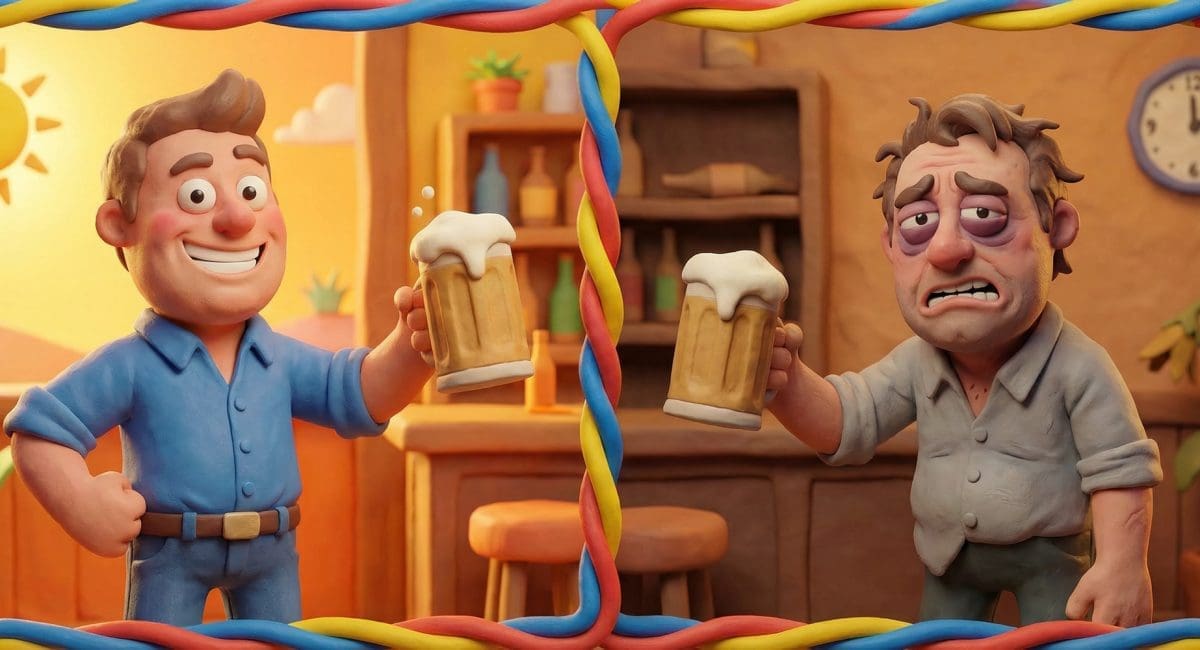
Why do hangovers get worse with age? If you’re asking, you already know the answer in your gut. The two-drink headache you’re nursing right now would have been nothing at 25. At some point in your 30s or 40s, the math stopped adding up. Same drinks, same night, completely different morning.
I noticed it with hard alcohol first. Didn’t matter how little I drank — whiskey, tequila, vodka — I’d feel like trash the next day regardless. So I cut it out. Then wine started doing the same thing. Red wine especially gives me headaches now, even after one glass. Champagne is a disaster. These days I stick to beer almost exclusively — just a couple if I’m not driving or staying in. Turns out that’s exactly what the biology would predict.
The science behind this is more specific than most people realize. A 2024 study from Stanford Medicine found that molecular changes across the human body cluster around two ages rather than accumulating evenly — the mid-40s and the early 60s. The mid-40s cluster included molecules involved in alcohol and caffeine metabolism. It reads less like a slow slide and more like a step change.
Here’s what’s actually happening inside your body — and what you can realistically do about it. For context on how high tolerance relates to hangover severity, that’s worth reading alongside this one.
Your Liver Is Working With Less
Your liver handles alcohol through two enzymes. The first — alcohol dehydrogenase (ADH) — converts alcohol into acetaldehyde, a highly toxic compound. The second — aldehyde dehydrogenase (ALDH) — converts that acetaldehyde into harmless acetate. This two-step process is how your body clears alcohol.
Both enzymes decline with age. Your liver produces less of them over time. So alcohol stays in your bloodstream longer, and acetaldehyde builds up faster than your body can clear it. Nausea, rapid heartbeat, pounding headache: that’s acetaldehyde at work.
It gets worse. Your liver uses an antioxidant called glutathione to neutralize acetaldehyde, and glutathione availability declines with age. So not only is your liver producing less of the enzyme that clears acetaldehyde — it also has fewer cleanup tools to deal with the backlog. The same two drinks that barely registered at 25 hit noticeably harder at 45. The alcohol content hasn’t changed. Your liver’s processing capacity has.
You’re Running Low on Water
Alcohol is water-soluble. When you drink, it distributes through your body’s water supply. The more water you have, the more diluted the alcohol gets — and the lower your blood alcohol concentration.
As you age, you lose muscle mass through a process called sarcopenia. Muscle tissue holds a lot of water. Fat tissue holds almost none. The result is that your total body water decreases meaningfully over the decades — commonly cited figures put it around 60% in young adult men dropping toward the low 50s by age 60, with a similar downward trend in women.
When an older adult and a younger adult drink the same amount, the older adult ends up with a higher blood alcohol concentration — even if their weight is identical. The alcohol has less water to spread through. Add that alcohol is a diuretic — it suppresses the hormone that tells your kidneys to hold water — and you’re draining a tank that was already running low. That’s where the severe headaches and dizziness come from. For the full picture on what to drink to counteract this, electrolytes are your best tool.
The Inflammation Double Whammy
When you drink, your body mounts an inflammatory response. Blood levels of inflammatory compounds — including IL-6, TNF-α, and C-reactive protein — spike after heavy drinking. These compounds drive the malaise, anxiety, irritability, and fatigue that define a bad hangover. Research in the Journal of Clinical Medicine confirms this inflammatory response is a primary driver of hangover severity.
Aging adds a complication called inflammaging — a chronic, low-grade inflammatory state that builds as you get older. Your baseline inflammation is already elevated before you take a single sip. When you drink, the alcohol’s acute inflammatory response stacks on top of that elevated baseline. Two fires burning at once.
This is why the same amount of alcohol that left you tired and headachy at 30 leaves you genuinely wiped out at 45. It’s not that you’ve become weaker. It’s that your inflammatory starting point has shifted, and alcohol pushes it into territory that takes much longer to recover from.
Your Brain and Sleep Are Working Against You
The aging brain becomes more sensitive to alcohol’s depressive effects. Older adults experience more pronounced impairment in balance, coordination, and cognitive function after drinking — even at blood alcohol levels that wouldn’t have been noticeable at 25.
Alcohol also disrupts sleep architecture. It may help you fall asleep faster, but it suppresses REM sleep and causes early awakenings. Sleep quality naturally declines with age anyway. When you add alcohol to an already-fragile sleep cycle, the compounding effect is brutal. You wake up after technically eight hours feeling like you got three. That heavy, foggy, can’t-think-straight feeling that gets worse with every birthday? This is why.
🔬 The Cliff at 44: What Stanford Actually Found
The Stanford Medicine study deserves its own section, with one important caveat attached. Researchers tracked more than 135,000 molecules and microbes in 108 people aged 25 to 75, sampling repeatedly over time and looking for patterns in how biological aging progresses.
What they found cuts against the idea that aging is a slow, even decline. The abundance of most molecules didn’t shift gradually with the calendar. Instead, changes clustered around two points: roughly age 44 and roughly age 60. In the mid-40s cluster, molecules involved in alcohol and caffeine metabolism were among those that shifted.
Here’s the caveat, and it matters. The study describes a correlation in a relatively small sample. It didn’t establish why those changes cluster where they do, and it didn’t measure hangovers at all. The “aging happens in bursts at 44 and 60” headline that circulated in 2024 ran ahead of what the data supports, and the paper drew published criticism on exactly that point. You can read the primary source yourself in Nature Aging.
So treat it as a suggestive finding that lines up with what a lot of people report, not as proof of a switch flipping on your 44th birthday. Many people do describe a specific window — somewhere between 42 and 46 — where hangovers feel categorically different rather than just a bit worse. The Stanford data is consistent with that experience. It doesn’t yet explain it.
The Paradox: Why Do Some Studies Say Hangovers Improve With Age?
Here’s where it gets interesting. Despite everything above, a 2021 study analyzing data from over 50,000 participants aged 18 to 94 found that reported hangover severity actually declined with age. The older the participants, the less severe they said their hangovers were — even after controlling for how much they drank.
So which is it? Does biology make hangovers worse, or do people report feeling better? Both things can be true. Scientists offer four explanations for the gap.
| Theory | Explanation |
|---|---|
| Decreased pain sensitivity | Overall sensitivity to pain decreases with age. Older adults may feel the same biological damage less acutely, which shows up in surveys as reduced severity. |
| Survivorship bias | People who respond severely to alcohol often reduce their drinking or quit entirely as they age. The older drinkers left in the studies are naturally the ones who tolerate it best. |
| Drinking habits | Older adults drink less frequently. When they do get a hangover, the contrast to their normal baseline feels sharper — making it feel worse even if clinical markers are lower. |
| Lifestyle adaptations | Older drinkers tend to pace themselves better, eat before drinking, and stay hydrated. These behaviors reduce actual hangover severity even as biological vulnerability increases. |
The honest take: surveys measure how people feel. Biology measures what’s actually happening. Older adults may perceive their hangovers as less severe while simultaneously experiencing more physiological strain from the same amount of alcohol. The perception and the biology diverge — and the biology is the part that matters for your long-term health.
What You Can Actually Do About It
The aging body isn’t broken — it’s operating under new constraints. Understanding those constraints lets you work with them rather than against them.
Drink less than you used to. The numbers matter here. If two drinks was your limit at 30, your functional limit at 45 is probably one. The same blood alcohol level is harder on an older body and takes longer to clear.
Stick to low-congener drinks. This is what I landed on through trial and error before I knew the science. Hard spirits — especially dark ones like whiskey, bourbon, and brandy — carry more congeners, and a declining ALDH enzyme has more to clear. Beer, particularly lighter styles, is lower in congeners than almost everything else. Our breakdown of how different types of alcohol hit differently goes deeper on this.
Hydrate aggressively. Your baseline body water is lower, your kidneys are less efficient, and alcohol will dehydrate you faster than it used to. Match every drink with a full glass of water. Add an electrolyte drink before bed — your depleted sodium, potassium, and magnesium stores need more than water alone to recover.
Consider DHM. Dihydromyricetin is thought to support the ALDH enzyme that clears acetaldehyde — exactly the enzyme your aging liver is producing less of. The mechanism is plausible and the preclinical work is interesting, but human evidence for hangover relief remains thin, so set expectations accordingly. Our DHM supplement guide covers what the research does and doesn’t show.
Eat before you drink. Protein and fat slow alcohol absorption significantly. A proper meal before drinking buys your liver time to process alcohol at a pace it can manage. Check out our guide on the best hangover foods for what works best.
Build in real recovery time. Drinking two nights in a row hits harder than it used to, and the cumulative fatigue compounds quickly. Two dry days minimum between sessions during the week is a reasonable floor.
Worth saying plainly: if you find you’re needing recovery strategies every time you drink — regardless of how much — that’s useful information about where your body is. The science-backed prevention game plan works best as an occasional tool, not a daily crutch.
Frequently Asked Questions
Why do hangovers get worse with age?
Several biological changes combine to make hangovers worse as you age. Your liver produces fewer enzymes to process alcohol, acetaldehyde builds up faster, total body water decreases so alcohol concentrates higher in your blood, chronic low-grade inflammation (inflammaging) amplifies alcohol’s inflammatory response, and sleep quality declines making next-day recovery harder. A 2024 Stanford study also found molecular changes clustering around age 44 that included alcohol metabolism.
At what age do hangovers start getting worse?
Most people notice a meaningful shift somewhere in their mid-30s, with a more pronounced change around the mid-40s. The Stanford Medicine study identified roughly age 44 as a point where biomolecular changes cluster, including molecules tied to alcohol metabolism. A second cluster occurs around 60. Individual experience varies widely.
Why does hard alcohol hit harder as you age?
Dark spirits like whiskey, bourbon, and brandy are higher in congeners — byproducts of fermentation that your liver must process alongside alcohol. As you age, the ALDH enzyme responsible for clearing acetaldehyde declines. The same whiskey that was manageable at 30 creates a bigger backlog at 45, resulting in a worse hangover.
Why does red wine cause headaches as you get older?
The leading explanation isn’t sulfites — that theory has largely been set aside by researchers. Current evidence points to quercetin, a compound concentrated in red grape skins, which interferes with the ALDH2 enzyme that clears acetaldehyde. Since ALDH activity already declines with age, that interference lands on a smaller reserve. Histamine sensitivity, which also tends to rise with age, can add flushing and congestion on top. We cover the full mechanism in our guide to the red wine headache.
Does everyone’s hangover get worse with age?
Not always — at least not in terms of how it’s perceived. A 2021 study of over 50,000 people found that older adults actually reported less severe hangovers. But researchers attribute this to decreased pain sensitivity, survivorship bias (heavy drinkers quit as they age), and better drinking habits — not improved biology. The physiological strain from the same amount of alcohol is greater in an older body even if it’s perceived as less severe.
What’s the best drink to avoid bad hangovers as you get older?
Lower-congener drinks are easier on an aging liver. Light beer and vodka are among the lowest in congeners. Dark spirits, red wine, and champagne (carbonation speeds absorption) tend to be the worst offenders. Staying hydrated and keeping volume low matters more than the specific drink — but switching from dark spirits to beer or clear spirits makes a noticeable difference for most people.
Sources
- Stanford Medicine. “Massive biomolecular shifts occur in our 40s and 60s, Stanford Medicine researchers find.” August 2024.
- Shen, X. et al. “Nonlinear dynamics of multi-omics profiles during human aging.” Nature Aging, 2024. (Primary source for the Stanford findings.)
- Verster, J.C. et al. “Alcohol Hangover Across the Lifespan: Impact of Sex and Age.” Alcohol and Alcoholism, 2021.
- van de Loo, A.J.A.E. et al. “The Inflammatory Response to Alcohol Consumption and Its Role in the Pathology of Alcohol Hangover.” Journal of Clinical Medicine, 2020.
- National Institute on Alcohol Abuse and Alcoholism. “Older Adults.” NIAAA.
- Harvard Health Publishing. “Alcohol and age: A risky combination.” January 2024.
- Healthline. “Why Do Hangovers Get Worse with Age?” August 2024.
- Live Science. “Why do hangovers get worse with age?” October 2024.
We take this seriously. Every health claim here is backed by studies and credible sources, and we cite them so you can check our work. But we’re researchers and writers, not doctors, and this article isn’t medical advice. Age-related changes in how you tolerate alcohol can also overlap with medications and health conditions, and you know your own history better than any website can. If anything here raises a question or concern, talk to a qualified healthcare provider — we genuinely encourage it. For more, see our full disclaimer.
🍺 A note before you go: Hangovers are miserable, but if you’re drinking to the point of needing recovery strategies on a regular basis, that’s worth paying attention to. There’s no judgment here — but there is help available if you want it. SAMHSA’s National Helpline is free, confidential, and available 24/7 at 1-800-662-4357.