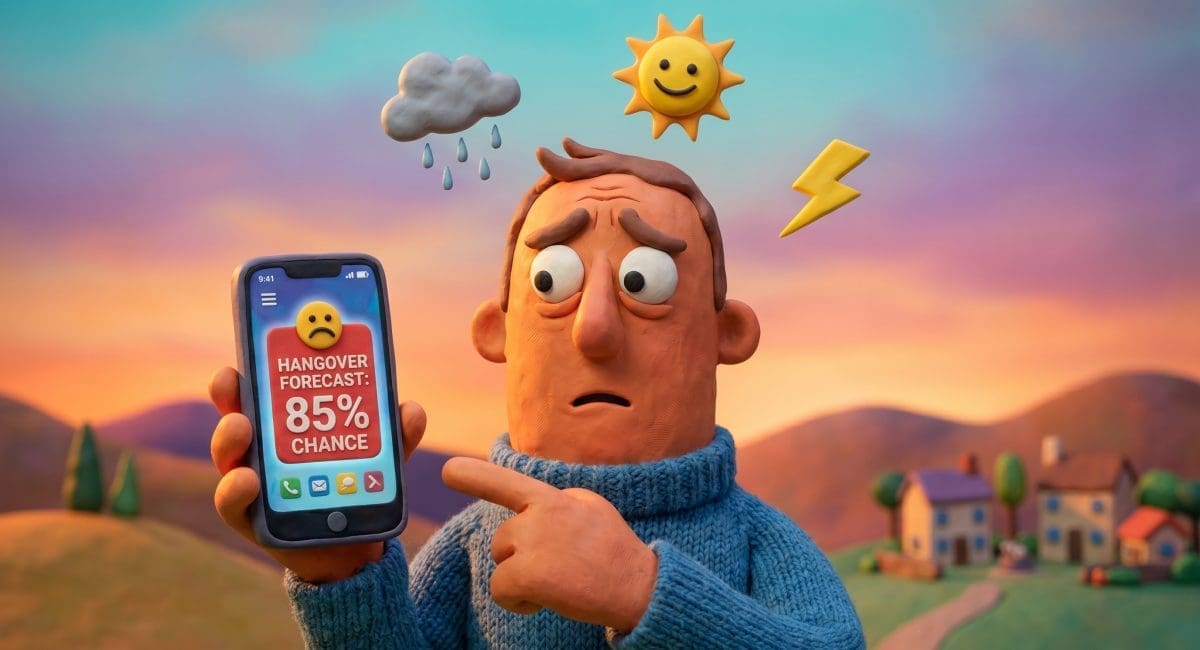
- The hangover risk forecaster predicts your hangover severity on a 1-10 scale based on your drinking plans and personal factors.
- You’ll get a personalized hangover prevention action plan with timing for food, water, and supplements.
- The “Show the Math” section reveals exactly how the hangover forecaster calculated your score.
- Try the “What If” scenarios to see how small changes shift your hangover forecast.
- The hangover risk forecaster is an estimate, not medical advice. Use it alongside your own judgment.
How rough will tomorrow be?
Tell the hangover forecaster your plans. We’ll predict your hangover and tell you what to do about it.
How much, how heavy, and what’s in the glass?
What’s going on around the drinking matters more than you think.
What you’re doing (or not doing) to soften tomorrow.
—
We built the hangover risk forecaster with real science and a lot of research, but let’s be clear: this is an estimate, not a medical diagnosis. Every body is different. Every drinking session is different. Genetics, medications, health conditions, and a hundred other factors can change how alcohol affects you tomorrow.
The hangover forecaster is one tool in your toolbox — use it alongside your own judgment, your own self-awareness, and your own research. You know yourself better than any calculator does. If you have health concerns, take medications, or wonder whether your symptoms might be more than a hangover, talk to a doctor.
Drink responsibly. Know your limits. And if things feel wrong, get help — the SAMHSA National Helpline is free, confidential, and available 24/7.
How the Hangover Risk Forecaster works
The hangover risk forecaster turns your drinking plans into a 1-10 hangover severity score. Then it hands you a plan to bring that score down. The hangover forecaster is built on the same factors hangover researchers actually study: alcohol volume, drink type, food intake, hydration, sleep, age, and pacing.
The output isn’t just a number. You get a personalized hangover prevention plan timed across three windows — before drinking, during drinking, and before bed. Each window includes specific moves backed by research, plus product recommendations when they fit your hangover risk profile.
Curious about the math? Tap “Show the math behind your score” after you calculate. You’ll see the base hangover calculation, every modifier that nudged your score up or down, and the final formula. No black boxes here — the hangover risk forecaster shows its work.
What the hangover risk forecaster measures
The hangover risk forecaster looks at nine factors that shape how hard a hangover hits. Each one has real research behind it, and each one feeds into your final hangover risk forecast.
Drink volume and body weight
More drinks mean more acetaldehyde — the toxic byproduct your liver creates while breaking down alcohol. Research shows acetaldehyde is a primary driver of hangover symptoms. Body weight matters because alcohol distributes through total body water. The same drink load hits a 130-pound person harder than a 200-pound person.
Drink type and congeners
Congeners are the chemical compounds produced during fermentation. Dark spirits like bourbon, brandy, and dark rum carry the highest congener loads. Studies have linked higher congener content to worse hangovers. Vodka, gin, and white wine sit at the low end. Sugary cocktails get a separate hit because added sugar accelerates dehydration and worsens the next-day crash.
Food, sleep, and hydration
Drinking on an empty stomach speeds alcohol absorption dramatically. Sleep matters because alcohol disrupts REM cycles even when you sleep a full night, and short sleep compounds the effect. Hydration baseline determines how quickly you’ll cross into the dehydration zone where most hangover misery lives.
Age, pacing, and prep
Hangovers really do get worse with age because liver enzyme efficiency drops and total body water decreases. Drinking pace matters because slower pacing gives your liver time to process before acetaldehyde piles up. And pre-drinking prep — DHM, B-vitamins, products like ZBiotics or Cheers — meaningfully reduces hangover intensity in research settings.
A controlled study had subjects drink equivalent amounts of bourbon and vodka on separate nights. Bourbon drinkers reported significantly worse hangovers despite identical alcohol intake. The culprit: congeners. Bourbon has roughly 37 times more.
How to read your hangover forecast score
The hangover risk forecaster’s 1-10 scale breaks into five tiers, each with a different morning reality. Your hangover forecast tells you what to expect.
1-2: You’ll be fine
Light intake, smart prep, decent sleep. Tomorrow won’t be a problem. You’re the person at brunch who annoyingly says they “feel great.”
3-4: Mild — slightly off
A bit of fog, maybe a low-grade headache. Coffee and water will reset you within an hour or two. Productive day still on the table.
5-6: Moderate — productive day at risk
Real symptoms. Headache, fatigue, possibly nausea. You can function with effort, but it’s a survival day, not a thriving day. Plan accordingly.
7-8: Brutal — clear your morning
This is the zone where calling out sick crosses your mind. Significant headache, nausea, exhaustion, possibly hangxiety. Recovery takes most of the day. Avoid scheduling anything important.
9-10: Reschedule everything
You’re going to be wrecked. This is also the zone where the hangover risk forecaster recommends paying extra attention to when symptoms cross from hangover to medical concern. Hydrate aggressively, rest, and know the warning signs.
The “if you must” approach to high forecast scores
The hangover risk forecaster doesn’t lecture you. If your hangover forecast lands in the rough zones, you’ll see “if you must” guidance — practical harm reduction for people who’ve already decided they’re going. Maybe it’s a wedding. A close friend’s birthday. The work event you can’t skip.
In those cases, you don’t need someone telling you not to drink. You need someone telling you how to make tomorrow survivable. That’s what the hangover action plan does. Our full prevention guide covers the deeper hangover science if you want more.
What the hangover risk forecaster doesn’t measure
A few things truly matter that the hangover forecaster can’t capture without becoming impossible to use. Genetics play a big role — some people lack efficient versions of the enzymes that break down alcohol. Medications interact unpredictably with alcohol. Underlying health conditions change everything.
The hangover forecaster also doesn’t know about your specific drink. A pint of high-ABV craft IPA isn’t the same as a domestic light beer, but both register as “beer” in the inputs. We weight averages, but your real-world hangover may shift based on details we can’t ask about.
If the hangover forecast feels off compared to your past experience, trust your experience. You have data on yourself we don’t.
Products mentioned in this article
Affiliate links labeled by network — buying through these supports the site at no cost to you.
| Product Type | What It Does | Where to Find |
|---|---|---|
| DHM Supplements | Dihydromyricetin — research-backed for reducing hangover severity when taken before or during drinking. | See our DHM guide |
| ZBiotics | Pre-alcohol probiotic targeting acetaldehyde breakdown in the gut. Take before your first drink. | Direct + Amazon |
| Cheers Restore | DHM-based formula taken after drinking. Targets liver function and hydration. | Direct + Amazon |
| Liquid I.V. | High-electrolyte hydration multiplier. One stick equals roughly 2-3 glasses of water for hydration. | Amazon |
| B-Complex Vitamins | Replenishes B vitamins depleted by alcohol metabolism. Take before drinking and the morning after. | Amazon |
Frequently asked questions
The hangover risk forecaster gives a research-grounded estimate based on the factors most strongly linked to hangover severity in published studies. It can’t account for genetics, medications, specific drink chemistry, or individual variation. Treat the forecast score as a directional indicator rather than a precise hangover prediction.
The hangover forecaster works for the main categories: light beer, regular beer, wine, clear spirits, dark spirits, and sugary cocktails. It uses average congener loads and ABV for each category. Specialty drinks — high-ABV craft beer, fortified wines, mixed drinks with energy drinks — may produce hangover forecast results that differ from the average.
Because those factors really do matter that much. Empty-stomach drinking can roughly double absorption rate. Short sleep compounds with alcohol-disrupted REM cycles. The “What If” feature in the hangover forecaster exists specifically to show you how much these levers move the outcome.
Some can, based on research. DHM (dihydromyricetin) has the strongest evidence for reducing hangover severity. It’s the supplement category most likely to drop your hangover forecaster score. Pre-alcohol probiotics like ZBiotics target a specific mechanism (acetaldehyde in the gut). B-vitamins help with replenishment. None of them are magic, but the data supports modest hangover improvements.
Take the hangover forecast seriously. A high score means significant alcohol intake combined with risk factors. Hydrate aggressively before bed, plan for a slow morning, and know the signs of when a hangover crosses into medical territory. If you’re vomiting repeatedly, can’t keep water down, or feel chest pain, get medical help.
Sources
- Mackus, M., et al. (2019). Alcohol Hangover and Multitasking — research on acetaldehyde and hangover severity.
- Rohsenow, D. J., et al. (2010). Intoxication With Bourbon Versus Vodka: Effects on Hangover.
- Sleep Foundation — Alcohol and Sleep Research Summary.
- National Institute on Alcohol Abuse and Alcoholism — Hangovers Fact Sheet.
- Shen, Y., et al. (2012). Dihydromyricetin as a novel anti-alcohol intoxication medication.