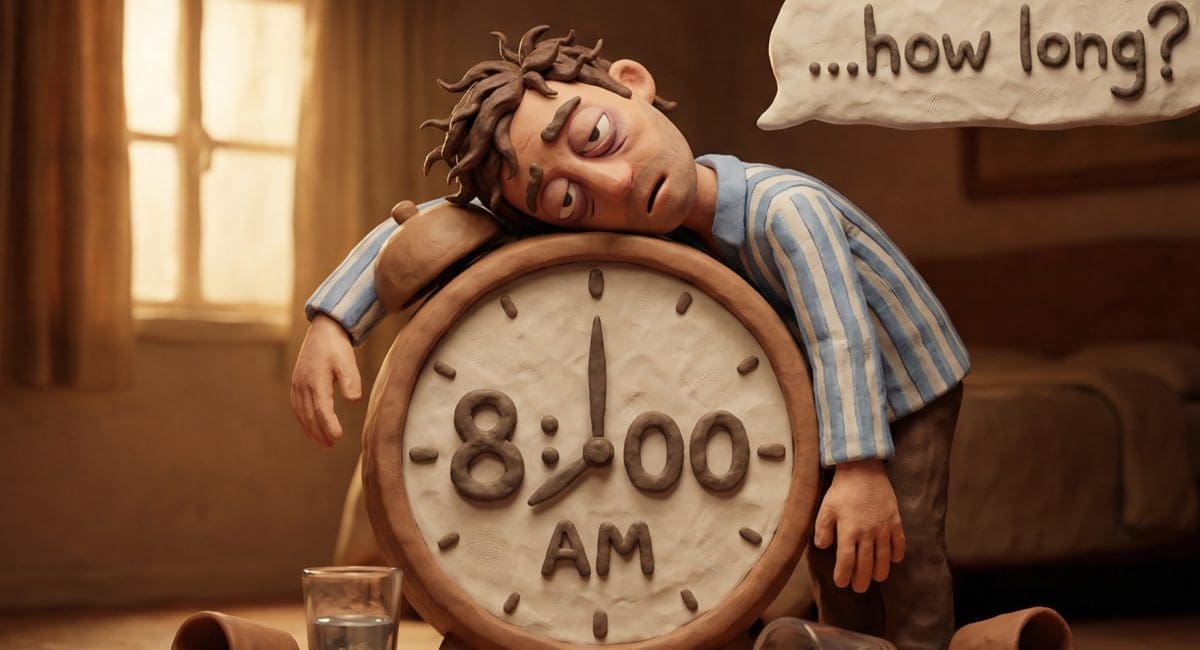
- Most hangovers last 14–24 hours, with an average of 18.4 hours after your last drink.
- Symptoms peak when your blood alcohol concentration hits zero — usually 6 to 12 hours after stopping.
- Heavy binges can stretch a hangover to 48–72 hours, especially without sleep, food, or water.
- Age, dark liquor, poor sleep, and an empty stomach all make it worse.
- Hydration plus rest is the fastest path back. No miracle cure exists.
You wake up with a hangover, stare at the ceiling, and ask the only question that matters right now: when does this end?
Good news — it ends. Bad news — probably not as fast as you’d like.
For most people, a hangover runs its course within 24 hours. But that number comes with serious fine print. Your age, what you drank, how much you slept, and whether you did anything to help yourself all play a role. A 22-year-old who drank vodka sodas and slept eight hours has a very different morning. So does a 45-year-old who put away a bottle of bourbon on four hours of sleep.
We’ve all been there — or at least somewhere on that spectrum.
The science on hangovers is more detailed than most people realize. Researchers have studied the timeline, the biology, and the factors that make some hangovers brutal and others manageable. This article breaks it all down. You’ll know what to expect, what actually helps, and why your hangovers keep getting worse every year.
Spoiler: that last part isn’t in your head.
The Short Answer: How Long Does a Hangover Last?
Most hangovers last between 14 and 24 hours. A peer-reviewed study in the Journal of Addiction Disorder and Rehabilitation surveyed over 800 drinkers. The average hangover duration was 18.4 hours after stopping drinking — roughly 12 hours from when you wake up.
So if you’re reading this at 8 a.m. on a Saturday, you’re probably looking at sometime around 8 p.m. before you feel human again.
Heavy drinking, poor sleep, and zero recovery effort can push that window to 48 hours. In serious binge-drinking cases, hangover symptoms can linger up to 72 hours. But for a typical night out, 24 hours is your benchmark.
Symptoms peak when your BAC hits zero
Here’s the part most people miss. Hangover symptoms don’t peak while alcohol is in your system. They peak when your blood alcohol concentration returns to zero — typically 6 to 12 hours after your last drink. That’s why you wake up feeling worst, not at 3 a.m. when you stumble in.
The body’s rebound from suppressed brain activity pairs with peak acetaldehyde clearance. That combo lands right around the time you’re trying to function the next morning. It’s not random. It’s biology with bad timing.
The Hangover Timeline: Hour by Hour
Here’s what’s happening from your last drink to the moment you finally feel okay again.
| Phase | Timing | What’s Happening |
|---|---|---|
| Still Drunk | Hours 1–6 | Alcohol is still in your system. No hangover yet — your liver is working through the backlog. |
| Arrival | Hours 6–10 | BAC drops toward zero. Early hangover symptoms start showing up — thirst, restlessness, vague dread. |
| Peak Misery | Hours 10–18 | BAC hits zero. Headache, nausea, fatigue, and sensitivity to light and sound peak. This is the valley. |
| Slow Recovery | Hours 18–24 | Hangover symptoms ease. Hydration and food help. Most people feel functional by the end of this window. |
| Extended Cases | 24–72 hours | Heavy drinking, dark spirits, poor sleep, or age-related factors can extend the misery well past 24 hours. |
How Long Each Hangover Symptom Lasts
Not every symptom clears at the same pace. Some fade by lunch. Others linger into the next day. Here’s what to expect for the most common ones.
| Symptom | Typical Duration | What Helps Most |
|---|---|---|
| Headache | 6–24 hours | Hydration, ibuprofen with food, dark room |
| Nausea | 4–12 hours | Bland food, ginger, electrolytes, time |
| Fatigue | Up to 24 hours | Sleep, food, light movement |
| Brain fog | 12–24 hours | Hydration, rest, low-stim environment |
| Hangxiety | 12–48 hours | Time, light walk, food, no caffeine |
| Light/sound sensitivity | 6–18 hours | Dim room, sunglasses, quiet |
Hangxiety is the outlier. Physical hangover symptoms tend to fade together as your body rehydrates and clears acetaldehyde. The mental fog and anxiety often hang on after the rest is gone.
What’s Actually Happening in Your Body During a Hangover
A hangover isn’t one problem — it’s five problems hitting you at the same time.
Dehydration is the most obvious culprit. Alcohol suppresses a hormone that tells your kidneys to hold onto fluid. Without it, you urinate far more than you take in. That’s where the cotton mouth, headache, and dizziness come from.
Acetaldehyde buildup is the villain most people don’t know about. When your liver breaks down alcohol, it produces acetaldehyde as a toxic byproduct. Your body clears it quickly under normal circumstances — but after heavy drinking, it builds up faster than it can be cleared. That’s what drives the nausea and that general feeling of being poisoned.
Inflammation explains why hangover symptoms feel like the flu. Alcohol triggers an immune response, releasing inflammatory proteins called cytokines throughout your body. Research published in the Journal of Clinical Medicine confirmed elevated cytokine levels in people experiencing hangovers. That accounts for the muscle aches, fatigue, and general misery beyond just being thirsty.
Disrupted sleep amplifies everything else. Alcohol might help you fall asleep, but it wrecks the quality of that sleep. It specifically destroys the deep REM sleep your brain needs to recover. You can sleep eight hours after drinking and still wake up exhausted.
Blood sugar drops add shakiness and weakness to the list. Alcohol interferes with your liver’s ability to release glucose, which can leave you mildly hypoglycemic by morning.
Put all five together and the full picture of a hangover starts to make sense.
Why Hangovers Get Worse With Age
If you’ve noticed that your hangovers hit harder and last longer than they used to, you’re not imagining it.
Age slows everything down. Your liver produces fewer metabolic enzymes as you get older. That means acetaldehyde lingers in your system longer before it gets cleared. Your body also holds less water as you age — more fat, less muscle. The same amount of alcohol hits harder. Dehydration sets in faster and deeper too, because your kidneys become less efficient at managing fluid balance over time.
The math is brutal. The same night out that gave you a rough morning at 25 can put you in bed until 6 p.m. at 45. We go deep on this in our guide on why hangovers get worse as you age. The short version: your biology just isn’t playing fair anymore.
Why Some People Don’t Get Hangovers (And Others Get Crushed)
You probably know that one person who drinks like a fish and bounces out of bed at 6 a.m. ready to run a 5K. There’s actual science behind why hangovers vary so widely.
Genetic enzyme differences
Your liver clears alcohol in two steps. First, an enzyme called ADH converts ethanol to acetaldehyde. Then ALDH2 converts acetaldehyde into harmless acetate. People with certain ALDH2 gene variants — common in East Asian populations — clear acetaldehyde slowly. They get flushed, nauseous, and miserable from a single drink.
On the flip side, some people inherit faster enzyme variants. Their bodies clear acetaldehyde quickly, so they feel less of the toxic-byproduct phase that causes nausea and inflammation.
Body composition and hydration
Younger people, well-hydrated people, and those with more lean muscle mass dilute alcohol more effectively. The same two drinks produce a lower peak BAC — and therefore less acetaldehyde to clear.
Tolerance is not protection
Frequent drinkers often think tolerance shields them. It doesn’t. Tolerance changes how drunk you feel, not how much damage your body absorbs. The hangover machinery — dehydration, acetaldehyde, inflammation, disrupted sleep — runs the same regardless of how sober you act at the bar. We break this down in our piece on why high tolerance doesn’t protect you from brutal hangovers.
Factors That Make a Hangover Last Longer
How long a hangover lasts depends on more than just how much you drank. Several factors can stretch a manageable hangover into a full-day ordeal.
What you drank matters more than most people realize. Dark spirits — bourbon, whiskey, brandy, dark rum — contain high levels of congeners. These chemical byproducts of fermentation significantly worsen hangover symptoms. A landmark study by Rohsenow et al. found that bourbon contains 37 times the congeners of vodka. Participants who drank bourbon reported notably worse hangovers than those who consumed the same amount of vodka.
Drinking on an empty stomach accelerates alcohol absorption and spikes your blood alcohol concentration faster. Food — especially protein, fat, and complex carbs — slows that absorption down considerably.
Sleep quantity and quality are huge. Research on hangover duration found a significant correlation between total sleep time and how long hangover symptoms lasted. Less sleep equals a longer, worse hangover.
Other factors that extend the misery: smoking while drinking and existing health conditions that affect how your liver processes alcohol. Mixing alcohol with certain medications also matters — antidepressants, antihistamines, and some antibiotics are common culprits. If you want to attack the problem from the other end, our hangover prevention game plan covers the full pre-game strategy.
Two-Day Hangovers: Are They Real?
Yes — but they’re not as mysterious as they seem.
A genuine two-day hangover almost always involves at least one of these factors. The list: a serious binge drinking episode, very little sleep, zero hydration or food, or drinking across two consecutive nights. It’s not that the hangover stretched — it’s that the hangover was never given any chance to resolve.
Johns Hopkins Medicine notes that hangovers can last up to 72 hours in extreme cases. That’s the ceiling, not the norm. If you hit your body hard and take no steps to recover, it takes longer to heal.
If you’re still rough at the 48-hour mark, drink water, eat something bland, and rest. If hangover symptoms are getting worse instead of better, that’s worth a call to your doctor.
Hangxiety: The Hangover Nobody Talks About
For a lot of people, the anxiety and low mood the morning after drinking are the worst part. Some call it hangxiety. The physical hangover symptoms are one thing. Feeling like something terrible is about to happen is another.
Here’s why it happens. Alcohol boosts your brain’s calming signals while suppressing the excitatory ones. When the alcohol clears, your brain overcorrects into a state of heightened anxiety. You feel restless, uneasy, and vaguely doomed — even if nothing is actually wrong.
Hangxiety can persist even after the physical hangover symptoms clear up. That means your total impairment window may be longer than 24 hours. This is especially common if you already deal with anxiety in everyday life. The good news: it passes. Time is the main remedy, just like the rest of it.
How to Get Rid of a Hangover Fast (What Actually Works)
There’s no magic cure — anyone selling one is lying to you. But several things actually move recovery along.
Hangover Recovery Checklist
- Drink 16–32 oz of water or electrolytes as soon as you wake up.
- Eat something bland — toast, crackers, a banana, broth.
- Take ibuprofen with food if you have a headache. Never Tylenol.
- Go back to sleep if you can. Repair work happens at rest.
- Skip the coffee if anxiety is part of your symptoms.
- Avoid hair of the dog. It delays recovery, doesn’t speed it.
- Step outside for fresh air once you can stand up without regret.
Hydration is the most important step. Water helps with the dehydration driving your headache and fatigue. Electrolyte drinks — sports drinks, coconut water, or oral rehydration solutions — restore the sodium and potassium lost through increased urination. Plain water is good; electrolytes are better. Our roundup of the best hangover drinks covers what actually works.
Sleep is your second most valuable tool. Your body does its best repair work while you rest. If you can go back to bed, go back to bed.
Food stabilizes blood sugar and settles your stomach. Bland is better — toast, crackers, bananas, broth. Greasy food sounds appealing but can irritate an already inflamed stomach and make nausea worse. We have a full guide on the best hangover foods if you want specific options.
⚠️ Important: Ibuprofen and aspirin are fine for hangover headaches — take them with food. Avoid Tylenol (acetaminophen) while alcohol is still being processed. It can cause serious liver damage when combined with alcohol metabolism. This is not a small risk.
For a deeper look at what works, check out our full guide on how to cure a hangover fast.
Hangover Myths That Won’t Save You
Hair of the dog delays your hangover, it doesn’t cure it. Drinking more temporarily raises your BAC and masks symptoms. But the hangover is waiting on the other side, and it may be worse.
Greasy food after the fact does very little. Food is most effective before and during drinking. After a hangover has set in, grease can irritate your stomach more than it helps.
Coffee makes you more alert but fixes nothing. Caffeine is also a diuretic — which means it can worsen the dehydration you’re already fighting.
Beer before liquor is a myth. Order doesn’t matter. Total consumption does.
When to Worry: Hangover vs. Alcohol Poisoning
⚠️ Medical Emergency Signs — Call 911
Most hangovers are unpleasant but not dangerous. Alcohol poisoning is different — and it’s a medical emergency. Call emergency services right away if someone who has been drinking shows any of these signs:
- Confusion or unconsciousness
- Vomiting while unconscious
- Seizures
- Slow or irregular breathing (fewer than eight breaths per minute)
- Blue, gray, or pale skin
- Very low body temperature
- Cannot be woken up
A hangover that gets progressively worse after 24 hours — rather than better — also warrants medical attention. Same goes for chest pain, difficulty breathing, or severe dehydration. When in doubt, get help.
Frequently Asked Questions
How long does a hangover last on average?
Most hangovers last between 14 and 24 hours from when symptoms begin. Research puts the average at around 18.4 hours after stopping drinking — roughly 12 hours from the time you wake up.
When do hangover symptoms peak?
Hangover symptoms peak when your blood alcohol concentration reaches zero. That’s typically 6 to 12 hours after your last drink. For most people, that lines up with the next morning.
Can a hangover last 2 days?
Yes, in cases involving heavy binge drinking, minimal sleep, and no hydration or food. Two-day hangovers are real but typically preventable with basic recovery steps. Symptoms that worsen after 48 hours are worth checking with a doctor.
Do hangovers get worse with age?
Yes. Your liver slows down, your body holds less water, and dehydration hits harder as you get older. The same amount of alcohol hits harder and takes longer to clear after your 30s.
How long does hangover nausea last?
Hangover nausea typically lasts 4 to 12 hours. Bland food, ginger, and electrolyte drinks help. Nausea that persists past 24 hours or includes blood is a reason to see a doctor.
How long does hangxiety last?
Hangxiety usually lasts 12 to 48 hours and can outlast the physical hangover. Time, fresh air, food, and skipping caffeine help most. People with existing anxiety often experience it more intensely.
Why do some people not get hangovers?
Genetics, body composition, hydration habits, and what they drink all play a role. Faster ALDH2 enzyme activity clears acetaldehyde quickly, which reduces the toxic-byproduct phase that causes most symptoms.
Does drinking water help a hangover?
Yes. Rehydrating addresses the dehydration driving headache, dizziness, and fatigue. Electrolyte drinks work better than plain water for restoring lost minerals.
What makes a hangover last longer?
Several things stretch a hangover. Dark spirits, drinking on an empty stomach, poor sleep, heavy consumption, smoking while drinking, and age all play a role.
Is there a cure for a hangover?
No proven cure exists. Time is the only guaranteed remedy. Hydration, sleep, bland food, and OTC pain relievers (not Tylenol) reduce symptoms but don’t eliminate the hangover.
Sources
- National Institute on Alcohol Abuse and Alcoholism (NIAAA) — Hangovers
- Mayo Clinic — Hangovers: Symptoms and Causes
- van Schrojenstein Lantman, Mackus & Verster (2018) — The Duration of the Alcohol Hangover, Journal of Addiction Disorder and Rehabilitation
- Rohsenow et al. (2009) — Intoxication with Bourbon versus Vodka, Alcoholism: Clinical and Experimental Research
- NIH/PMC — The Impact of Alcohol Hangover Symptoms on Cognitive and Physical Functioning, Journal of Clinical Medicine
- Johns Hopkins Medicine — Hangover Headache
- Drinkaware — Alcohol and Hangxiety
- MedlinePlus Medical Encyclopedia — Hangover Treatment
- Harvard Health Publishing — 7 Ways to Cure Your Hangover
- UCLA Health — Time Is the Best Cure for a Hangover
If hangovers are showing up more often, lasting longer, or starting to shape your routine, that’s worth attention. No judgment — patterns can creep up on anyone. The SAMHSA National Helpline is free, confidential, and available 24/7 at 1-800-662-4357 if you ever want to talk to someone.