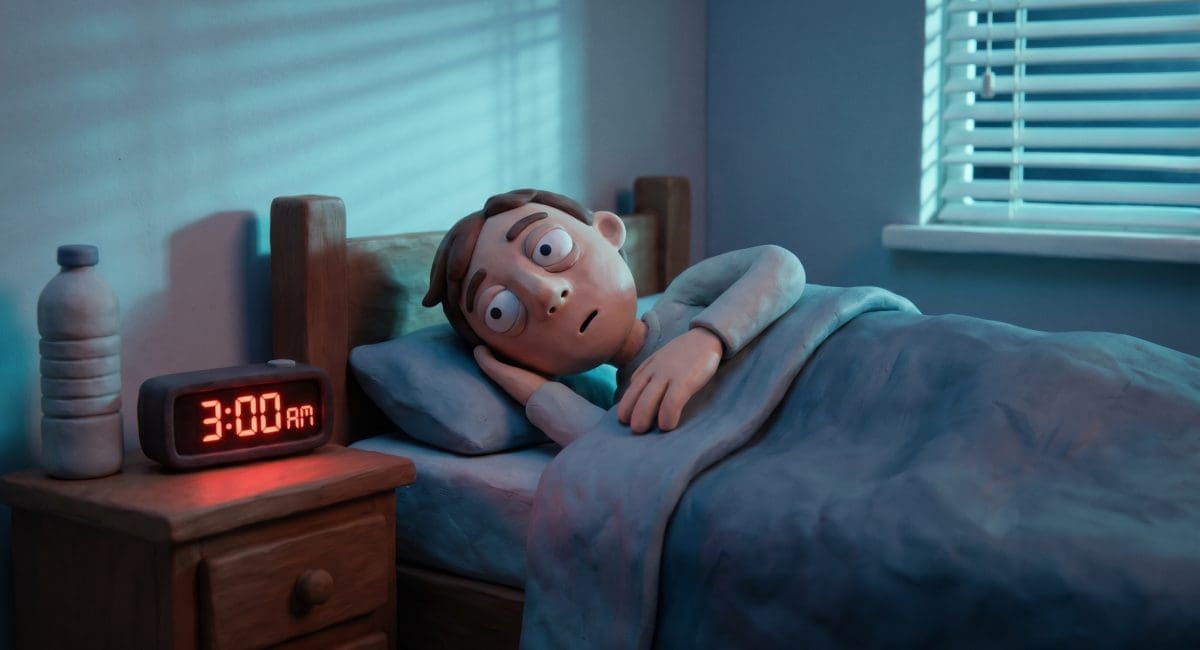
- Sleep after drinking alcohol feels broken because alcohol sedates you fast in the first half of the night and wrecks the second half
- The 3 AM wake-up is your cortisol, blood sugar, and nervous system rebounding all at once
- REM sleep takes the biggest hit — that’s the stage your brain needs for memory, mood, and recovery
- Best moves right now: drop the room to 66–70°F, sip water with electrolytes, eat a small protein-and-carb snack, and skip the phone
- Next time: stop drinking 3–4 hours before bed, hydrate between drinks, and skip the nightcap myth entirely
Sleep after drinking alcohol is one of life’s cruelest jokes. You crash hard. You congratulate yourself for falling asleep fast. Then you jolt awake at 3 AM with your heart pounding. Sound familiar?
Here’s the cruel part — that quick knockout was the problem, not the solution. Alcohol doesn’t put you to sleep. It sedates you and then yanks the rug out a few hours later. Your brain spends the rest of the night trying to recover from the chemistry experiment you ran on it.
I’ve stared at more 3 AM ceilings than I care to admit. The good news: there’s actual science behind how alcohol affects sleep. And there are specific moves that help. Some work right now if you’re reading this mid-crisis. Others prevent the whole mess next time you drink.
Why drinking ruins your sleep — the short version
Sleep after drinking alcohol breaks for one reason. Alcohol works as a sedative early in the night and a stimulant later. You fall asleep fast because alcohol boosts GABA, the brain chemical that slows you down. As your liver clears the alcohol, your nervous system rebounds — spiking cortisol and waking you up around 3 AM.
That paradox is the whole story. Your brain gets sedated. Your sleep architecture gets scrambled. The second half of the night turns into a low-grade chemistry experiment.
The rest of this guide breaks down how alcohol affects sleep at each stage. We’ll cover why REM sleep takes the biggest hit and why 3 AM keeps showing up. Plus what actually helps, both right now and next time.
What alcohol actually does to your sleep cycle
To understand how alcohol affects sleep, start with the normal pattern. A typical night cycles through four to six 90-minute sleep cycles. Each one moves through light sleep, deep sleep (also called slow wave sleep), and REM sleep. Alcohol breaks that pattern in two distinct phases. The second phase is where you pay the price.
First half — the sedative knockout
Alcohol hits your brain’s GABA receptors. GABA is the chemical that slows everything down. It’s also what most prescription sleep aids target. When alcohol boosts GABA activity, your brain quiets, your muscles relax, and you fall asleep faster than you would sober.
So far so good, right? Not really. What you’re getting is sedation, not sleep. Sedation skips the normal early stages and dumps you into slow wave sleep faster than usual.
You also get a temporary boost in slow wave sleep during the first half of the night. That sounds like a feature until you see what happens next.
Second half — the rebound
Your liver processes about one standard drink per hour. That’s roughly 12 ounces of beer, 5 ounces of wine, or 1.5 ounces of liquor. Once the alcohol clears your system, the chemistry flips hard.
GABA activity drops back to normal. Your sympathetic nervous system kicks on. Cortisol and adrenaline spike. Glutamine — a stimulating brain chemical that alcohol suppressed earlier — rebounds and overshoots its normal level.
The result is a hyperaroused state right when you should be in your deepest sleep. This rebound shows up around 3 to 4 hours after your last drink. For most people, that lands between 2 and 4 AM. The earlier you stopped drinking, the earlier the rebound hits. The more you drank, the harder it hits.
| Sleep stage | Normal night | After drinking |
|---|---|---|
| Sleep onset | 15–20 minutes | 5–10 minutes (faster, but worse) |
| Slow wave (deep) sleep | 13–23% of night | More in 1st half, less in 2nd |
| REM sleep | 20–25% of night | Suppressed 1st half, fragmented rebound 2nd |
| Awakenings | 0–2 brief | 3–8+ fragmented |
| Overall quality | Restorative | Shallow and broken |
REM sleep, alcohol, and why your brain pays the price
REM sleep — short for rapid eye movement — is when your brain does its heaviest mental work. Memories get consolidated. Emotions get processed. Creative connections get formed. Dr. Matthew Walker, a professor of neuroscience and psychology at UC Berkeley, calls REM “overnight therapy.” He’s also the founder of UC Berkeley’s Center for Human Sleep Science.
Alcohol attacks REM from two directions. First, it suppresses REM in the first half of the night when REM cycles would normally be ramping up. Second, when the alcohol clears, REM rebounds aggressively in the second half. The rebound is fragmented and shallow, though, so it doesn’t deliver the same benefits.
A 2024 systematic review and meta-analysis tested even low doses of alcohol — about two standard drinks. The result: measurably reduced REM sleep. Higher doses suppress REM further in the first half of the night. Then they trigger fragmented REM rebound in the second half. The dose-response curve is steep and consistent.
This is why you wake up irritable, anxious, and foggy after drinking. Your brain didn’t get the REM it needed. That deficit shows up the next day as mood swings and poor concentration. It also creates the emotional thinness that often turns into next-day hangxiety.
Why you wake up at 3 AM after drinking
The 3 AM wake-up after drinking happens because four things converge at once. Your liver finishes metabolizing the alcohol. GABA activity drops. Cortisol and adrenaline spike. Blood sugar crashes. Your brain shifts from sedation to a hyperaroused state — and you snap awake.
Alcohol suppresses your central nervous system while you’re drinking. When it clears, your system rebounds in the opposite direction. It’s basically a mini-withdrawal — anyone can experience it, not just heavy drinkers.
Each mechanism on its own would disturb sleep. Together they form a wake-up storm that’s nearly impossible to sleep through. Here’s how each piece works.
Cortisol spike. As alcohol leaves your system, your adrenal glands release cortisol — your body’s main stress hormone. Cortisol normally peaks in the early morning to wake you up gradually. Alcohol withdrawal triggers a sharper spike that hits hours before it should.
Blood sugar crash. Alcohol blocks gluconeogenesis, which is your liver’s ability to produce glucose. Your blood sugar can drop significantly overnight, especially if you didn’t eat much. Low blood sugar triggers more cortisol and adrenaline, which jolts you awake.
Glutamine rebound. Your body suppresses glutamine production while you’re drinking. When the alcohol clears, glutamine production rebounds and overshoots normal levels. Glutamine is a natural stimulant, so the overshoot leaves you wired.
REM rebound. All that suppressed REM from earlier in the night comes flooding back at once. The rebound comes in chaotic, fragmented bursts — often with vivid, anxiety-tinged dreams. You’re far more likely to wake during these bursts than during normal REM.
If you also wake up drenched, you’re feeling all of these mechanisms hit at once. The hangover night sweats symptom and the 3 AM wake-up share the same chemical chaos.
Alcohol, snoring, and sleep apnea — a bad combination
Even if you don’t have a diagnosed sleep disorder, alcohol can manufacture one for the night. The mechanism is mechanical. Alcohol relaxes the muscles in your throat and tongue. Those relaxed muscles partially block your airway, which makes you snore — sometimes thunderously.
For people with sleep apnea, alcohol makes the condition significantly worse. Sleep apnea is a disorder where you stop breathing momentarily during sleep, then jolt awake to gasp. Both the Cleveland Clinic and Sleep Foundation flag alcohol as a major aggravator.
Do you wake up gasping, or snore loudly enough to wake your partner? Feel exhausted even after a long sleep? Those are signs worth taking to a doctor. Alcohol can unmask undiagnosed sleep apnea by making it noticeably worse on drinking nights.
How long before bed should you stop drinking?
The general guideline from sleep researchers is to stop drinking 3 to 4 hours before bed. That window gives your liver time to process the alcohol before you try to sleep. Earlier is better, but 3 hours is the floor where most of the disruption noticeably eases.
Here’s the math. If you go to bed at midnight, your last drink should land no later than 8 or 9 PM. If you go to bed at 11, your last drink lands around 7 or 8. This sounds boring. It’s also the single biggest lever you have on next-day sleep quality.
The amount matters too. The dose-response curve in the meta-analysis is steep. Two drinks affect REM sleep measurably. Five drinks affect everything — sleep onset, REM, fragmentation, the 3 AM wake-up. You can stop drinking 4 hours before bed and still wake up wrecked if you drank heavily.
Combine the timing rule with hydration between drinks. You’ve already eliminated most of the next-morning damage before it starts.
What to do right now if you can’t sleep after drinking
If you’re reading this at 2 or 3 AM, this section is for you. These six moves can get you back to sleep faster. Run through them in order.
- Drop the room to 66–70°F. Your body is fighting a temperature dysregulation battle. A cool room gives it somewhere to dump heat. Crack a window or kick on the AC.
- Sip water with electrolytes. Plain water helps. Electrolytes help more. Sodium, potassium, and magnesium support nervous system regulation. Products like LMNT, Liquid I.V., or Pedialyte work well. Keep a bottle on the nightstand.
- Eat a small protein-and-carb snack. A banana with peanut butter, a handful of nuts, or crackers and cheese. The goal is to stabilize the blood sugar crash. Don’t eat a huge meal — just enough to reset the dip.
- Take a cool (not cold) shower. Lukewarm water lowers your skin temperature without shocking your system. A freezing shower triggers a vasoconstriction rebound that can make sweating worse.
- Skip the phone. Blue light suppresses melatonin. Your sleep is already wrecked. Don’t make it worse. If you have to look at a screen, use night mode or grayscale.
- Try slow nasal breathing. Inhale through your nose for 4 counts. Hold for 4. Exhale through your mouth for 4. Repeat for 5 to 10 minutes. This activates your parasympathetic system and counteracts the cortisol-driven hyperarousal.
If your sleep stays trash after the wake-up, focus on damage control the next day. Our guide on how long a hangover lasts covers recovery timing. Most symptoms peak around 8 to 10 hours after your last drink.
How to sleep better the night you drink (prevention)
Prevention beats recovery every time. If you know you’re going to drink, these moves stack the deck before you sit down.
Stop drinking 3 to 4 hours before bed. The single biggest lever, as covered above. Build it into your evening. Pick a “last call” time mentally before you start drinking.
Drink water between alcoholic drinks. Alternating one for one slows your consumption, supports your liver, and reduces dehydration. The hangover prevention game plan covers the full hydration math.
Eat real food before and during drinking. Food slows alcohol absorption, which means a lower peak BAC and less acetaldehyde buildup. Protein, carbs, and fats all help. Skip the empty-stomach drinking even if you’re trying to “save calories.” You’ll pay for it tenfold.
Skip the nightcap. The whole point of this guide is that alcohol is bad for sleep. A drink right before bed gets all the disruption with none of the social benefit. Have a glass of water or herbal tea instead.
Take magnesium glycinate. Magnesium helps your nervous system stay calm. Glycinate is the easiest-absorbed form for most people. This isn’t a magic bullet, but it stacks well with the other moves.
Consider DHM. Dihydromyricetin is a compound from the Japanese raisin tree. Early research shows promise in reducing alcohol-related sleep disruption. Our best DHM supplements guide breaks down the options.
When sleep problems after drinking become a bigger issue
Most sleep disruption after drinking is annoying but temporary. Some patterns deserve more attention. If any of these describe you, talk to a doctor.
You need alcohol to fall asleep. If you can’t sleep without drinking, you’ve moved past “alcohol affects my sleep.” You’re now dependent on alcohol for sleep. It’s a recognized clinical pattern, and it’s treatable.
Your sleep problems persist for weeks after stopping. Acute alcohol disruption fades within a few nights. Sleep problems that linger for weeks suggest something deeper. It’s often an underlying sleep disorder that alcohol was masking, or changes that need professional support.
You’re drinking more to get the same sleep effect. Tolerance to alcohol’s sedative effects develops in as little as three days of nightly drinking. Once you’ve moved from one drink to three for the same drowsy effect, the path back gets harder. Our piece on why high tolerance doesn’t prevent hangovers covers this in more depth.
You wake up gasping or your partner notices breathing pauses. Those are possible signs of sleep apnea, which alcohol significantly worsens. Get it evaluated by a sleep specialist.
Sleep after drinking alcohol FAQ
Why can’t I sleep after drinking alcohol?
You probably are sleeping — just badly. Alcohol fragments your sleep into a sedated first half and a hyperaroused second half. The wake-ups around 2 to 4 AM come from cortisol spikes, blood sugar crashes, and rebound nervous system activation. You’re getting more time in bed than time in restorative sleep.
Does alcohol affect REM sleep?
Yes, significantly. Even two drinks measurably reduce REM sleep. Higher doses suppress REM further in the first half of the night and trigger fragmented REM rebound in the second half. REM is critical for memory, mood, and emotional regulation, which is why you feel mentally thin the day after.
Why do I wake up at 3 AM after drinking?
Four mechanisms converge around 3 AM. Your liver finishes metabolizing the alcohol. Cortisol spikes. Blood sugar crashes. Your nervous system rebounds from suppression. The exact timing depends on how much and when you drank. Most people land in the 2 to 4 AM window.
How long does alcohol affect sleep?
Most acute effects resolve within one to two nights of sober sleep. Sleep architecture typically normalizes within 3 to 5 nights. Heavy or chronic drinking can produce changes that take weeks or longer to fully resolve.
Can alcohol cause insomnia?
Yes. Both occasional and regular drinking can trigger insomnia patterns. Occasional disruption is acute and fades quickly. Regular nighttime drinking can create dependence-based insomnia that worsens over time and persists even after stopping.
Does one drink before bed really matter?
It matters more than most people realize. One drink shortly before bed still reduces REM sleep and increases fragmentation. The effect is smaller than five drinks, but it’s not nothing. A 3 to 4 hour buffer between your last drink and bed makes a real difference.
Sources
- Sleep Foundation — Alcohol and Sleep
- Cleveland Clinic — Why You Should Limit Alcohol Before Bed for Better Sleep
- ScienceDirect — The effect of alcohol on subsequent sleep in healthy adults: A systematic review and meta-analysis (2024)
- NIH/NCBI — Sleep, Sleepiness, and Alcohol Use
- NIH/NCBI — Sleep after Heavy Alcohol Consumption and Physical Activity Levels during Alcohol Hangover
If alcohol keeps interfering with your sleep, that’s worth paying attention to. There’s no judgment in noticing the pattern. The SAMHSA National Helpline is free, confidential, and available 24/7 at 1-800-662-4357. They can connect you with local support and resources if you’d like to talk to someone.