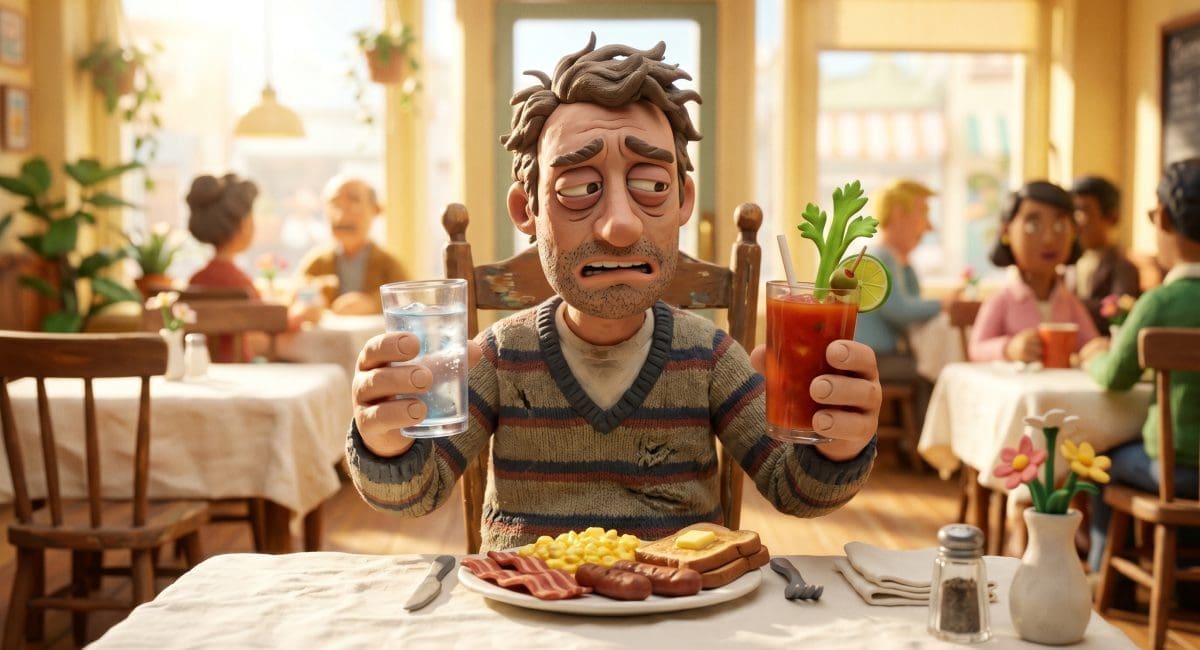
The hair of the dog cure is either the best idea you’ve ever heard or the worst, depending on who you ask. Your doctor says don’t do it. Your buddy with the Bloody Mary says it’s the only thing that saved him Sunday morning.
Here’s the thing — they’re both right.
There’s actual science behind why drinking more alcohol temporarily relieves a hangover. It’s not just wishful thinking or an excuse to keep the party going. But there’s a catch, and it’s a biochemical one. Understanding it will change how you think about that morning-after mimosa forever.
Let’s break it all down — the weird history, the real science, and the honest verdict on whether the hair of the dog cure actually works.
What Is the Hair of the Dog Cure?
The hair of the dog cure refers to drinking alcohol the morning after a heavy night to relieve hangover symptoms. The name comes from an old folk remedy that claimed placing hair from a rabid dog into a bite wound would cure the infection. The logic: fight the cause with more of the cause.
That sounds insane by modern standards. But the phrase stuck, and so did the practice. Today it shows up at every Sunday brunch in America — in Bloody Marys, mimosas, and “just a little something” poured into morning coffee.
People have debated whether hair of the dog actually works for centuries. The science finally has an answer — and it’s more interesting than a simple yes or no.
📚 Cross-reference: We tagged hair of the dog as Busted in our roundup of hangover myths from around the world. That call still stands — it’s not a cure. But the science behind why people swear it works is genuinely fascinating, and it deserves more than a one-paragraph dismissal. That’s what this piece is for.
A Brief (And Surprisingly Weird) History
The hair of the dog cure isn’t a modern invention. Humans have been drinking through their hangovers for a very, very long time.
The earliest known reference dates back to ancient Ugarit — modern-day Syria — somewhere around 1200 BCE. A text called “God’s Hangover” describes the god ‘Ilu suffering through a brutal morning after a drinking binge. The prescribed remedy involved a salve made from a plant, olive oil, and the hair of a dog applied to his forehead. Even the gods needed a recovery plan.
The “Like Cures Like” Philosophy
The phrase itself comes from a medical concept called sympathetic medicine, which was hugely popular in early modern Europe. The idea was simple: whatever caused your problem could also fix it. If a rabid dog bit you, the cure was to place hair from that specific dog into the wound.
Nobody said ancient medicine was pretty.
By the 16th and 17th centuries, physicians started applying this logic to alcohol. Venetian physician Santorio Santorio — working from humoral theory — suggested that drinking more alcohol could restore the body’s natural balance after overindulgence. A 1634 annotated copy of the Salernitan Regimen of Health put it plainly: drink early the next morning to mend what wine hath broken.
How It Became a Brunch Staple
The literal dog hair faded out quickly — thankfully. But the metaphor planted itself permanently in drinking culture. By the 20th century, the hair of the dog cure had evolved from folk medicine into a brunch institution.
It’s a concept that has survived ancient mythology, medieval medical theory, and several thousand years of bad mornings. That kind of staying power tells you something — even if what it tells you is mostly that humans really hate hangovers.
Why Your Body Hates You the Morning After
Before you can understand why hair of the dog works at all, you need to know why hangovers feel so brutal in the first place. A hangover isn’t one thing. It’s a pile of biochemical miseries happening at the same time.
- Dehydration: Alcohol suppresses vasopressin, the hormone that tells your kidneys to hold onto water. You lose more fluid than you take in, which is why your mouth feels like sandpaper.
- Acetaldehyde toxicity: Your liver breaks ethanol down into acetaldehyde — a toxic compound — before converting it into harmless acetate. When acetaldehyde builds up faster than your liver can clear it, you get nausea, sweating, and a racing pulse.
- Inflammation: Alcohol triggers an inflammatory response that floods your system with cytokines. This causes the muscle aches, headaches, and brain fog that make mornings feel like a personal attack.
- Blood sugar crash: Alcohol blocks your liver from producing glucose. Low blood sugar means fatigue, weakness, and mood that can charitably be described as “not great.”
- Wrecked sleep: Alcohol knocks you out but destroys your REM sleep. You wake up feeling like you ran a marathon in your sleep — because your brain basically did.
That’s a lot of simultaneous problems. Now here’s where it gets interesting — because a morning drink actually addresses some of them, temporarily.
The Real Reason Hair of the Dog Actually Works
Most people think the hair of the dog cure works because alcohol numbs the pain. That’s partially true. But the deeper answer is more fascinating — and it involves a chemical you’ve probably never thought about.
The Methanol Theory
Every alcoholic drink contains ethanol — the stuff that gets you drunk — plus tiny amounts of methanol, a toxic byproduct of fermentation. Your liver uses the same enzyme, alcohol dehydrogenase (ADH), to process both of them.
Here’s the problem: when ADH breaks down methanol, it produces formaldehyde and formic acid. Both are highly toxic and contribute significantly to severe hangover symptoms.
⚗️ The key detail: ADH strongly prefers ethanol over methanol. As long as there’s ethanol in your system, your liver processes that first and basically ignores the methanol. Only after all the ethanol is gone does it turn its attention to the methanol — and start producing those toxic byproducts.
When you wake up hungover, your body is in the process of clearing methanol metabolites. Drinking a morning beer or Bloody Mary introduces fresh ethanol. Your liver immediately pumps the brakes on methanol processing to handle the new ethanol instead. The formaldehyde production pauses. You feel better.
As Dr. Joe Schwarcz of McGill University explains it, while the enzymes are busy metabolizing the ethanol, methanol gets excreted in urine without being converted to formaldehyde. That’s temporary relief with an actual biochemical explanation behind it.
Worth noting — the methanol theory is one proposed mechanism, not settled medical consensus. Other researchers point to the GABA rebound effect (covered next) as a more reliable explanation for why people feel better after a morning drink. Both are likely contributing.
The GABA Rebound Effect
The methanol theory isn’t the only mechanism at work. There’s also what happens to your brain during and after drinking.
Alcohol boosts GABA — your brain’s main calming neurotransmitter — while suppressing glutamate, the excitatory one. Your brain adapts overnight by down-regulating GABA and ramping up glutamate receptors to compensate.
When the alcohol clears your system, your brain is suddenly in a hyper-excitable state. That’s where hangxiety comes from — the inexplicable anxiety, restlessness, and sensitivity to light and sound that makes the morning feel like sensory warfare.
A hair of the dog drink reintroduces alcohol, temporarily calms that overactive nervous system, and makes you feel human again. Until it wears off. And then you’re back where you started — plus the new alcohol you just added to the equation.
The Catch (And It’s a Big One)
So yes, the hair of the dog cure provides real relief. Biochemically, there’s a mechanism behind it. But here’s the honest truth: it’s borrowed time, and the interest rate is brutal.
Your body still has to metabolize everything eventually. The methanol processing just got delayed, not cancelled. The inflammation is still there. The dehydration is still there. And now you’ve added a fresh round of ethanol for your liver to deal with on top of everything else.
You’re not curing the hangover. You’re rescheduling it — and the rescheduled version tends to show up angrier.
There’s also a pattern worth being honest about. Regularly using alcohol to relieve the after-effects of drinking can blur into something more concerning over time. It’s worth keeping an eye on. If it feels like a routine rather than a one-off, that’s a signal worth taking seriously.
The Cocktails Built for the Morning After
Despite the medical caveats, drinking culture has spent centuries perfecting the hair of the dog experience. Some of these cocktails are genuinely worth knowing about — both for the history and because, if you’re going to do it anyway, some choices are smarter than others.
The Bloody Mary
The most famous morning-after drink in the world, the Bloody Mary became popular in the 1920s and 30s. Its reputation as a hangover cure isn’t entirely without merit when you look at the ingredients.
- Vodka: A clear spirit with very few congeners — including methanol. Less methanol going in means less methanol to process the next morning. Dark spirits like whiskey and bourbon have significantly higher congener counts, which is part of why whiskey hangovers tend to hit harder.
- Tomato juice: Hydration, vitamin C, and lycopene. Not a cure, but not nothing either.
- Salt and spices: Help replenish lost electrolytes and give your senses something to focus on besides the misery.
Is a Bloody Mary a hangover cure? No. Is it the most defensible hair of the dog option from a biochemistry standpoint? Arguably yes.
The Corpse Reviver
The name alone earns this cocktail a place in history. The Corpse Reviver family of drinks dates back to the 19th century and was formalized in the 1930 Savoy Cocktail Book, where they were explicitly described as morning-after remedies designed to revive the drinker.
The most popular version — Corpse Reviver No. 2 — combines gin, Cointreau, Lillet Blanc, lemon juice, and a rinse of absinthe. It’s boozy, bracing, and named after the experience of coming back from the dead. Which is exactly how a bad hangover feels.
There’s something poetic about a drink that’s been purpose-built for suffering for nearly 200 years. It doesn’t work any better than a Bloody Mary from a science standpoint. But it has significantly more style.
Does Hair of the Dog Work? The Honest Verdict
The short answer: Yes, you’ll feel better temporarily — and for real biochemical reasons. The methanol theory and the GABA rebound effect are legitimate proposed mechanisms, not just folklore. But feeling better and being cured are different things.
The honest answer: It delays the inevitable, adds more load to a body that’s already struggling, and kicks the real recovery down the road. The NIAAA’s position is clear — your worst hangover symptoms hit when blood-alcohol drops to zero. A morning Bloody Mary just pushes that crash to the afternoon. You’re rescheduling, not curing.
The practical answer: If you’re going to do it anyway, vodka-based drinks are the smarter choice over dark spirits, and you should be drinking water alongside them, not instead of it.
The actual path out of a hangover is less exciting but more effective. Rehydrate aggressively with water and electrolytes. Eat something with carbs to bring your blood sugar back up. Take ibuprofen for the headache — not acetaminophen, which can stress an already-taxed liver. And give your body the time it needs to clear the toxins.
None of that is as fun as a Bloody Mary. But it actually moves the needle.
Frequently Asked Questions
Does hair of the dog work for hangovers?
Yes, temporarily. Drinking alcohol the morning after delays methanol processing in your liver and calms the neurological rebound your brain experiences after drinking. This provides real but short-lived relief. The hangover isn’t cured — it’s postponed.
Why does drinking more alcohol help a hangover?
Two mechanisms are at work. First, fresh ethanol competes with methanol for the same liver enzyme, temporarily halting the production of toxic methanol byproducts. Second, alcohol calms the brain’s over-excited state caused by the GABA and glutamate rebound after drinking.
What is the best hair of the dog drink?
If you’re going to do it, vodka-based drinks like a Bloody Mary are a smarter choice than dark spirits. Vodka has fewer congeners — including methanol — than whiskey, bourbon, or rum, so you’re adding less fuel to the fire. The tomato juice and electrolytes in a Bloody Mary don’t hurt either.
Is hair of the dog dangerous?
For most people in a one-off situation, it’s not dangerous — just counterproductive. It prolongs recovery and adds more strain to your liver. The bigger concern is using it regularly as a hangover strategy, which can be an early indicator of alcohol dependence.
What actually cures a hangover?
Time is the only true cure. The most effective support strategies are hydration with water and electrolytes, carbohydrate-rich food to raise blood sugar, ibuprofen for headaches (not acetaminophen), and rest. Nothing eliminates a hangover — you can only make the recovery faster and more comfortable.
Sources
- National Institute on Alcohol Abuse and Alcoholism — Hangovers
- Wikipedia — Hair of the Dog
- Swift R, Davidson D. Alcohol Hangover: Mechanisms and Mediators. Alcohol Health and Research World
- Northwestern Medicine — The Science of a Hangover
- Schwarcz J. The Chemistry of a Hangover. McGill University Office for Science and Society
- Becker HC. Neurochemical Mechanisms of Alcohol Withdrawal. Handbook of Clinical Neurology
- Laderer A. Hair of the Dog: Debunking the Hangover Cure Myth. Business Insider
- Thomas M. The Hair of the Dog and Other Hangover Cure Fallacies. Monash Lens
If you find yourself relying on alcohol to get through the morning after — regularly — that pattern is worth paying attention to. There’s no judgment here; drinking culture makes these habits easy to fall into. The SAMHSA National Helpline is free, confidential, and available 24/7 at 1-800-662-4357 if you ever want to talk to someone.