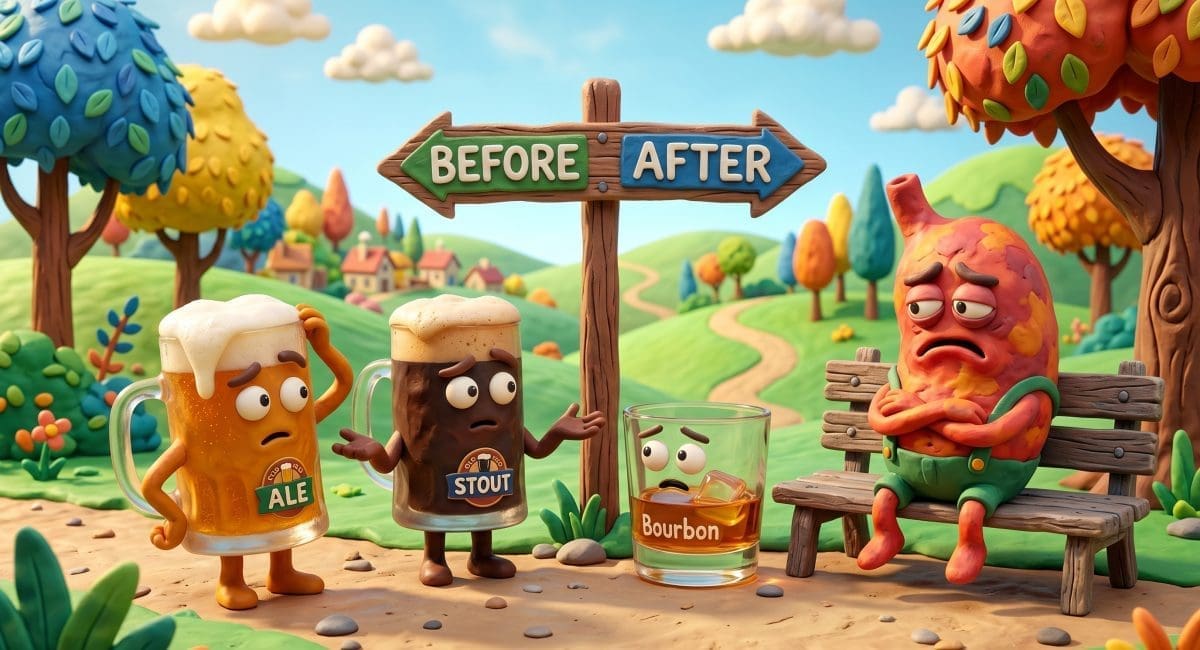
- “Liquor before beer, never been sicker” is a myth — a 2019 randomized controlled trial found drink order made no measurable difference to hangover severity.
- Your liver processes ethanol the same way no matter what glass it came from.
- The rhyme feels true because of pacing and judgment, not chemistry — shots go down in seconds, beers force you to slow down.
- What actually drives your hangover: total alcohol volume, congener content, hydration, food, and sleep.
- Carbonation (like in beer) can speed up alcohol absorption slightly — a minor factor, not a reason to trust the rhyme.
“Liquor before beer, you’re in the clear. Beer before liquor, never been sicker.” You’ve heard it at every party, tailgate, and bar crawl since college. It sounds scientific enough to be true. It rhymes, which makes it feel even more legit. But does the order you drink actually protect you from a hangover?
Short answer: no. The idea that liquor before beer prevents hangovers is a myth. However, there are some real reasons it feels true — and understanding those reasons might actually help you avoid that next-morning misery.
The rhyme everyone swears by
Nearly every culture has some version of this drinking rule. In Germany, they say “Bier auf Wein, das lass sein” — beer after wine, leave that be. The British version warns “grape or grain, but never the twain.” Americans landed on the beer-before-liquor version that’s practically tattooed on every frat house wall.
The logic behind these sayings sounds reasonable on the surface. Start with the strong stuff while your judgment is still sharp. Then coast through the rest of the night on lighter drinks. Your body handles the heavy lifting early, and the beer coasts you toward the finish line.
It’s a tidy theory. It’s also wrong.
What the science actually says about liquor before beer
The most-cited study on drink order comes from researchers at Witten/Herdecke University in Germany and the University of Cambridge. Published in 2019 in the American Journal of Clinical Nutrition, this randomized controlled trial recruited 90 volunteers between ages 19 and 40.
The setup was thorough. One group drank beer first, then wine. A second group drank wine first, then beer. A third group stuck to either beer or wine all night. A week later, the groups switched their order. Researchers scored everyone’s hangover the next morning on the Acute Hangover Scale.
The result? Drink order made no meaningful difference. People felt equally terrible regardless of the sequence. The only reliable predictor of hangover severity was how drunk someone felt and whether they vomited.
The study’s big limitation
Here’s something most articles skip entirely. The 2019 study tested beer and wine — not beer and liquor. As Snopes noted, dozens of news outlets misrepresented the findings. They claimed the study “proved” the liquor-before-beer myth false when it never actually tested liquor.
That said, the study’s core finding still holds up. Your liver processes ethanol the same way regardless of the glass it came from. A shot of vodka and a pint of beer deliver roughly the same amount of pure alcohol. Your body doesn’t care about the brand. It cares about the total ethanol load.
Why liquor before beer feels true (even though it isn’t)
If the science doesn’t back the rhyme, why does it seem to work for so many people? The answer isn’t biology — it’s behavior.
The pacing effect
A shot takes five seconds to finish. A beer can last 30 to 45 minutes. When you start with liquor and switch to beer, you naturally slow down your pace. Your liver gets more time to process each drink before the next one arrives.
Flip that sequence — start with slow beers, then switch to fast shots — and you’re escalating the speed of alcohol hitting your system precisely when your judgment is already impaired. You drink faster, make worse decisions, and stack drinks on top of each other.
The judgment problem
After three or four beers, your ability to gauge “how drunk am I?” drops off a cliff. At that point, switching to spirits is like handing the car keys to the worst version of yourself. You think you can handle another round of shots because the beer “wasn’t that strong.”
Meanwhile, your blood alcohol is already climbing. You’re not as invincible as your high tolerance suggests. Beer before liquor doesn’t make you sicker because of chemistry. You just drink more of it, faster, because your beer-soaked brain stopped keeping score.
The escalation bias
There’s also a simple memory bias at play. Nights that go from light drinks to heavy drinks tend to end badly because they’re escalation nights. You start casual, the vibe picks up, and suddenly you’re doing tequila shots at midnight. Those are already the nights where total consumption is highest.
Nights that go from strong to mild tend to be “winding down” nights. You start at happy hour, then coast. Liquor before beer feels safer because those nights naturally involve less total drinking. It’s not the drink order saving you — it’s the overall drinking pattern.
What actually makes your hangover worse
Whether you go beer before liquor or the other way around, drink order is noise. Here’s what actually drives how bad your hangover gets — and how long it sticks around.
Total alcohol volume
This is the biggest factor by far. Your liver can process about one standard drink per hour. Every drink above that pace is backlog. More backlog means more acetaldehyde — the toxic compound your body creates while breaking down alcohol. More acetaldehyde means a worse morning.
Congeners — the hidden hangover fuel
Congeners are chemical byproducts of fermentation and aging. Darker drinks like bourbon, brandy, and red wine contain significantly more of them than clear spirits like vodka or gin.
A 2010 study published in Alcoholism: Clinical and Experimental Research found that bourbon — a high-congener spirit — produced noticeably more severe hangovers than vodka at the same blood alcohol level. The ethanol did the damage either way, but congeners made it worse.
| Drink | Congener Level | Hangover Risk |
|---|---|---|
| Vodka | Very low | Lower (relatively) |
| Gin | Low | Lower |
| White wine | Low–moderate | Moderate |
| Beer (light lager) | Moderate | Moderate |
| Tequila (100% agave) | Moderate | Moderate |
| Red wine | High | Higher |
| Whiskey / Bourbon | High | Higher |
| Brandy / Cognac | Very high | Highest |
Hydration and food
Alcohol is a diuretic. It tells your kidneys to flush water faster than you’re replacing it. That dehydration drives headaches, fatigue, and brain fog the next day. Drinking on an empty stomach also speeds absorption and makes everything worse.
Eating before and during a night out slows gastric emptying. That means alcohol enters your small intestine — where most absorption happens — more gradually. It’s one of the simplest and most effective hangover prevention strategies out there.
Sleep quality
Alcohol fragments your sleep architecture. It may knock you out fast, but it destroys REM sleep — the restorative phase your brain needs. This gets worse with age, which is why the same six-beer night that barely dented you at 25 now wrecks your entire Saturday at 40.
The carbonation factor nobody talks about
Here’s where the beer-before-liquor myth actually gets interesting. Beer is carbonated. And carbonation changes how your body absorbs alcohol.
A 2007 study published in the Journal of Forensic and Legal Medicine found that vodka mixed with carbonated water was absorbed significantly faster than vodka mixed with still water. The carbon dioxide creates pressure in your stomach. That pressure pushes alcohol into your small intestine faster, where it hits your bloodstream quicker.
This means beer — a carbonated drink — can prime your stomach for faster absorption of whatever comes next. If you drink beer first and then switch to liquor, the carbonation from the beer may speed up how fast those spirits enter your bloodstream.
So there’s a tiny kernel of truth buried in the myth. It’s not that liquor before beer protects you — it’s that carbonation primes the pump for faster absorption. However, the effect is modest compared to factors like total volume and pace. Don’t mistake a minor absorption wrinkle for permission to plan your night around a rhyme.
What to do instead of trusting a rhyme
Forget the beer before liquor folklore. Here’s what actually works, based on science and (speaking from past experience) plenty of painful trial and error.
- Pick one type of drink and stick with it. Not because mixing is chemically worse — but because tracking your intake is easier with a single drink type. You know what four beers feels like. You don’t know what two beers plus a cocktail plus a shot feels like.
- Eat a real meal before you drink. Fat and protein slow absorption. A burger before happy hour does more for hangover prevention than any drinking-order strategy.
- Alternate every drink with water. This slows your pace, fights dehydration, and gives your liver breathing room.
- Choose lighter-colored spirits when possible. Vodka and gin carry fewer congeners than bourbon and brandy. This alone won’t save you, but it reduces one hangover-amplifier.
- Watch your pace, not your sequence. One drink per hour is the rough guideline. Your liver doesn’t care what’s in the glass — it processes about 0.015 BAC per hour regardless.
- Stop before you feel drunk. If you’re relying on a rhyme to protect you, you’ve probably already passed the point of “a couple drinks with friends.”
For the full breakdown, check out our Hangover Prevention Game Plan — it covers everything from DHM supplements to pre-game nutrition to morning-after recovery steps. That advice beats liquor before beer every single time.
Frequently asked questions about liquor before beer
Does drinking liquor before beer prevent a hangover?
No. The order of your drinks does not prevent a hangover. Your liver processes ethanol the same way whether it comes from beer, wine, or spirits. What matters most is total alcohol consumed, your pace, hydration, and whether you ate beforehand.
Is “beer before liquor, never been sicker” true?
No. The saying is a myth. A 2019 randomized controlled trial found that drink order had no meaningful effect on hangover severity. The only reliable predictors were how drunk participants felt and whether they vomited during the night.
Why does mixing beer and liquor seem to make hangovers worse?
Mixing drinks usually leads to higher total alcohol consumption. It’s harder to track how much you’ve had when you’re switching between beer, cocktails, and shots. The increased volume — not the mixing itself — drives the worse hangover.
Does the type of alcohol affect your hangover?
Yes, somewhat. Darker drinks like bourbon, brandy, and red wine contain more congeners — toxic byproducts of fermentation that can make hangovers worse. Clear spirits like vodka and gin contain fewer congeners. However, total alcohol consumed remains the most important factor.
Does carbonation in beer make you absorb alcohol faster?
Research suggests yes. Carbon dioxide creates pressure in the stomach, which can push alcohol into the small intestine faster. A 2007 study found that carbonated mixers increased alcohol absorption rates compared to still mixers.
Sources
- Köchling et al., “Grape or grain but never the twain?” — American Journal of Clinical Nutrition, 2019
- Rohsenow et al., “Intoxication with Bourbon versus Vodka: Effects on Hangover, Sleep, and Next-Day Performance” — PMC / Alcoholism: Clinical and Experimental Research, 2010
- Roberts & Robinson, “Alcohol Concentration and Carbonation of Drinks: The Effect on Blood Alcohol Levels” — Journal of Forensic and Legal Medicine, 2007
- Snopes — “Sleuthing Whether ‘Beer Before Liquor Makes You Sicker'”
- University of Cambridge — “Wine before beer, or beer before wine? Either way, you’ll be hungover, study finds”
Hangoverstan is about smarter choices, not more drinking. If you find yourself regularly needing hangover advice — or if alcohol is affecting your work, relationships, or health — it might be worth talking to someone. The SAMHSA National Helpline is free, confidential, and available 24/7 at 1-800-662-4357.