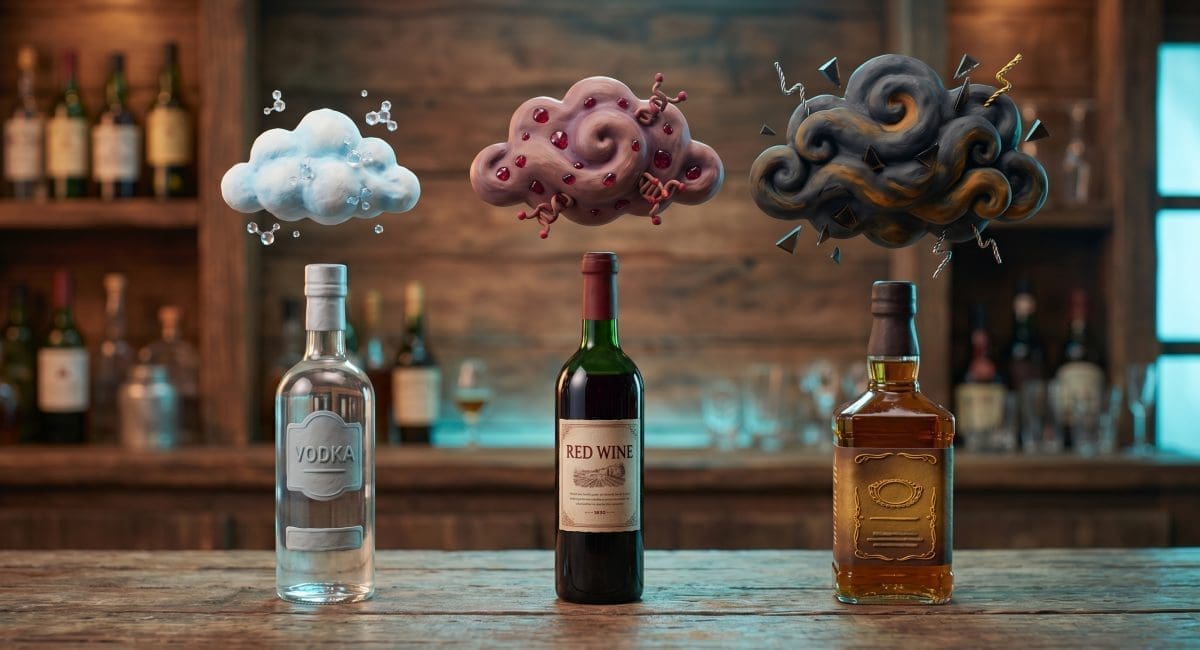
- Hangover severity by drink type comes down to two things: ethanol load and congeners (fermentation byproducts).
- Clear spirits like vodka and gin produce the mildest hangovers; dark spirits like bourbon and cognac produce the worst — bourbon carries up to 37x more congeners than vodka.
- Tequila’s bad reputation is mostly about mixto tequila. 100% agave blanco tequila is much milder, closer to white wine.
- Red wine hangovers often include a distinct headache driven by histamines, separate from a typical alcohol hangover.
- Beer’s low congener content helps, but its lower ABV means people drink more total volume to catch a buzz.
- Mixing drink types doesn’t create new toxins — it just makes it easier to lose track of how much you’ve actually had.
Why do different alcohol hangovers hit so differently the next morning? It comes down to chemistry, not karma. Three glasses of red wine can flatten you while three vodka sodas barely register, and the science behind that gap is surprisingly clean.
You wake up after a night of drinking and run a damage check before your eyes even open. Sometimes it is mild fog and dry mouth. Other times a construction crew sets up shop inside your skull. The hangover severity gap is rarely about willpower or hydration alone.
Different drinks cause different hangovers because each carries its own chemical load. Beer, wine, and spirits each bring their own troublemakers — and those troublemakers determine how rough tomorrow morning is going to be. Below, we break down why hangover effects vary so much by drink type, and how to use that knowledge at the bar tonight.
The science behind different alcohol hangovers
Two factors drive almost every hangover difference between drinks: ethanol load and congeners. Ethanol is the alcohol that gets you drunk. Congeners are everything else.
When alcohol ferments and distills, ethanol is not the only chemical produced. The process also creates trace amounts of other biologically active compounds — methanol, isopentanol, acetone, acetaldehyde, and others. These are congeners, and they give dark liquors and wines their flavor, aroma, and color.
They also wreck your morning. Your liver has to break down congeners alongside ethanol, and the byproducts trigger inflammatory responses that pile onto standard hangover symptoms. Research from the National Institute on Alcohol Abuse and Alcoholism identifies methanol specifically as a major driver of hangover severity, since its metabolic byproducts are far more toxic than ethanol’s.
The general rule of thumb works almost every time: the darker the alcohol, the higher the congener load, and the worse the hangover.
Spirits: where hangover severity diverges most
Liquor shows the congener rule most clearly. Hangover severity within the spirits category can vary wildly — two bottles can have identical alcohol content and produce wildly different mornings.
Clear liquors (vodka, gin, light rum) — the mildest hangovers
Clear spirits are heavily distilled and filtered, which strips out most congeners. Vodka in particular is essentially ethanol and water. Your body only has to process the ethanol, so clear liquors generally produce the mildest alcohol hangovers in the spirits category.
Gin sits in a similar zone. The botanicals add flavor without adding meaningful congener load, so gin hangovers stay relatively mild. Light rum follows the same pattern as long as you avoid the dark and spiced versions, which sit in a different hangover bracket entirely.
Dark liquors (whiskey, bourbon, dark rum, cognac) — the worst hangovers
Dark spirits are aged in wooden barrels, a process that intentionally introduces and preserves congeners to build complex flavor. Bourbon contains up to 37 times more congeners than vodka by some measurements.
A controlled study published in the journal Alcoholism: Clinical and Experimental Research compared bourbon and vodka at matched alcohol doses. Bourbon drinkers reported significantly more severe hangovers and worse next-day cognitive performance than vodka drinkers — same ethanol, different morning. If brutal hangovers are a recurring problem, switching from whiskey to vodka is one of the simplest preventative moves available.
I have to flag this one personally. I still have nightmares about a particular tequila bottle with a small red sombrero perched on the lid — the kind of bottle that ends up on a college bar shelf for a reason. That brand and I had several rough negotiations over the years, and the brand always won.
Here is the thing, though: tequila has a worse hangover reputation than the chemistry deserves — but only if you read the label. 100% agave tequila, especially blanco (silver) bottles, is moderate-congener territory. Hangover-wise it sits closer to white wine than bourbon. The blue agave fermentation and double distillation produce a relatively clean spirit when nothing else is added.
The problem is mixto tequila. Mixto only requires 51% blue agave by Mexican law, with the other 49% coming from cheaper sugars like cane. Mixtos are often loaded with caramel coloring, glycerin, and added sugars — which is why the worst tequila hangovers (red sombrero included) almost always involve a well shot, not a sipping añejo.
The lesson learned the hard way: if the bottle says “100% de agave,” congener-wise you are roughly in white-wine hangover territory. If it does not say that, you are rolling dice. Additives and congeners both compound hangover severity, and mixtos stack both. Volume on top of that is how nightmares get made.
Wine: the sulfite and histamine factor
Wine hangovers are notoriously brutal, often featuring a pounding localized headache that vodka simply does not produce. Wine contains congeners, but it also brings two other troublemakers that drive different hangover symptoms in this category: sulfites and histamines.
Red wine — high-histamine hangovers
Red wine ferments with the grape skins intact, which gives it color and high antioxidant content. The same process drives up congeners and histamines. Histamines trigger an inflammatory response similar to an allergic reaction — blood vessels in the brain dilate, and the result is the dreaded red wine headache — a distinctly different hangover from what straight liquor produces.
According to medical commentary on histamine sensitivity, what most people call a red wine migraine is technically a histamine reaction. The mechanism is different from a typical alcohol hangover headache, which is part of why red wine produces such a distinctive flavor of suffering.
White wine — milder but not innocent
White wine ferments without the skins, so it carries fewer congeners and histamines than red. However, white wine often contains higher sulfite levels, since sulfites are added as preservatives to prevent oxidation.
True sulfite allergies are rare, but some people are sensitive enough to feel it in the form of a low-grade hangover. Overall white wine produces a milder hangover than red, but it still ranks worse than clear spirits.
Beer hangovers: the volume problem
Beer occupies a unique slot in the alcohol hangover hierarchy. Chemically, beer has a relatively low congener load compared to dark spirits and red wine. It also has high water content, which actually helps offset alcohol’s dehydrating effects.
So why do beer hangovers happen at all? Volume and carbonation drive hangover severity in beer drinkers more than congener load does.
Because beer has a lower alcohol by volume — typically 4% to 7% — you have to drink more liquid to reach the same buzz as a shot of liquor. That volume leads to bloating, gastrointestinal distress, and sleep disruption from frequent bathroom trips. The carbonation in beer (and in tonic, soda, and seltzer mixers) also speeds alcohol absorption into the bloodstream, which can spike blood alcohol concentration faster than your system handles well.
Light beer vs. craft beer hangovers
Not all beer hangovers feel the same. Mass-produced light lagers are heavily filtered and have very low congener levels — they are almost the vodka of the beer world. Craft beers, especially heavy stouts, porters, and unfiltered IPAs, contain significantly more congeners, residual yeast, and hops.
The hierarchy inside beer is real: light lager sits near white wine for hangover risk, while a barrel-aged imperial stout can hit closer to dark rum territory. Same alcohol category, very different hangovers.
The hangover hierarchy at a glance
Here is how the major drink categories stack up by hangover severity, holding total alcohol intake roughly constant.
| Rank | Drink type | Congener level | Why it hits this way |
|---|---|---|---|
| 1 (mildest) | Vodka, gin, light beer | Very low | Heavy filtration removes congeners; mostly ethanol and water |
| 2 | White wine, blanco tequila (100% agave) | Low to moderate | Some congeners, sulfites in wine; clean fermentation in agave |
| 3 | Light rum, craft lagers | Moderate | Modest congener load, varies by brand |
| 4 | Heavy IPAs, stouts, porters | Moderate to high | Higher hop content, residual yeast, sometimes barrel aging |
| 5 | Dark rum, mixto tequila, aged tequila | High | Barrel aging plus additives in mixtos compound symptoms |
| 6 | Red wine | High + histamines | Congeners plus histamine reactions trigger headaches |
| 7 (worst) | Whiskey, bourbon, cognac, brandy | Highest | Long barrel aging packs in maximum congener content |
Brandy and cognac actually contain up to 4,766 milligrams of methanol per liter, while beer comes in around 27 milligrams per liter. That is a 175x difference in just one congener.
The mixing myth and hangover severity
You have heard the saying: “Beer before liquor, never been sicker; liquor before beer, you’re in the clear.” It is catchy, and it raises a fair question: does drink order actually matter? Not as an explanation for why drinks cause different hangovers — the chemistry doesn’t back the rhyme.
From a pure chemistry standpoint, mixing different drinks does not create a new super-toxic compound in your stomach. The order does not matter. What matters is total ethanol and total congener load by the time you stop drinking.
However, mixing drinks tends to mean drinking more in absolute terms. People lose track of consumption when shifting between a 5% beer, a 13% wine, and a 40% spirit, since each has a different alcohol load per serving. The mixing rhyme survives because mixers usually drink more, not because the order does anything chemically.
How to use this at the bar tonight
Knowing how alcohol-induced hangovers vary by drink type is only useful if it changes what you order. A few practical moves that work with the science:
- Default to clear spirits on heavy nights. Vodka soda or gin and tonic gives your liver the cleanest fuel and the lightest hangover risk.
- Avoid the dark + sweet combination. Dark rum and Coke is a congener payload plus a sugar crash — a guaranteed rough hangover.
- If you love red wine, pace it differently. Histamine reactions are not dose-dependent the same way ethanol is — even moderate amounts can trigger a wine hangover in sensitive drinkers.
- Read the tequila label. “100% de agave” is your friend for milder hangovers. Anything else is a mixto and a coin flip.
- Light lager beats craft IPA for hangover-conscious drinking, even when the craft beer tastes better.
- Hydrate alongside, not after. Water between drinks helps with the volume issue and the dehydration angle simultaneously, regardless of what alcohol you chose.
None of this makes alcohol hangover-proof. Drink enough of any alcohol and your liver will tap out, regardless of which one you picked. But understanding why drink type affects hangover severity gives you a fighting chance at a functional morning. Lower-congener drinks paired with hydration are the cleanest path through. For more on what to do if you wake up rough anyway, see our guide to curing a hangover fast and the best hangover drinks for recovery.
FAQ: drink type and hangover severity, answered
What alcohol gives you the worst hangover?
Whiskey, bourbon, cognac, and brandy produce the most severe hangovers in controlled studies, driven by their high congener content from extended barrel aging. Red wine ranks just behind because of its combined congener and histamine load. If your goal is the mildest possible morning, vodka and gin are your safest bets.
Does tequila really cause worse hangovers than other liquors?
It depends entirely on what you drank. 100% agave blanco tequila is moderate-congener and roughly comparable to white wine in hangover risk. Mixto tequila — which contains added sugars, caramel coloring, and other additives — produces much rougher mornings. Tequila’s bad reputation comes mostly from cheap mixtos served as shots, not from the spirit itself.
Why is red wine worse than white wine for hangovers?
Red wine ferments with grape skins still attached, which produces higher levels of both congeners and histamines. Histamines specifically can trigger inflammatory headaches that feel different from typical alcohol hangovers. White wine has less of both compounds, though some white wines contain higher sulfite levels that affect sensitive drinkers.
Is beer better or worse than liquor for hangovers?
Beer typically produces milder hangovers than dark liquor on a drink-for-drink basis, since beer has lower congener content and high water volume. However, beer’s lower alcohol percentage means people often drink more total volume, and carbonation speeds alcohol absorption. Light lager beats whiskey for the next morning. Heavy craft IPA can rival dark rum.
Does mixing alcohol types make hangovers worse?
Mixing drinks does not create new toxic compounds in your stomach, despite the popular saying. The actual cause is that people who mix drinks usually consume more total alcohol, and they also expose their liver to a wider variety of congeners at once. The order — beer before liquor or vice versa — has no effect. Total volume and total congener load determine your morning.
What is the lowest hangover alcohol?
Vodka and gin produce the lowest hangover risk among popular drinks, since both are heavily filtered and contain minimal congeners. Light lager beer ranks similarly low if you control for total alcohol intake. Among wines, dry white wine sits below red. Among tequilas, 100% agave blanco is the cleanest option.
Sources
- National Institute on Alcohol Abuse and Alcoholism — Alcohol Hangover: Mechanisms and Mediators
- PMC — Intoxication with Bourbon versus Vodka: Effects on Hangover, Sleep and Next-Day Neurocognitive Performance
- PubMed — The role of beverage congeners in hangover and other residual effects of alcohol intoxication
- Healthline — Congeners: How They Affect Alcohol and Hangovers
- GoodRx — Common Ingredients in Alcoholic Drinks That Worsen Hangovers
- Baylor College of Medicine — Hangovers Q&A with Dr. Stephen Harding
If drinking is causing repeated rough mornings, missed obligations, or genuine concern from people around you, the pattern matters more than the chemistry of any single drink. The SAMHSA National Helpline is free, confidential, and available 24/7 at 1-800-662-4357 — no judgment, no commitment, just a starting point if you want one.